MCQ
The appropriate reagent for the transformation
  • A
    $Zn(Hg),\,HCl$
  • $N{H_2}N{H_2}O{H^ - }$
  • C
    ${H_2}/Ni$
  • D
    $NaB{H_4}$

Answer

Correct option: B.
$N{H_2}N{H_2}O{H^ - }$
b
(b) Both $Zn(Hg),\,HCl$ and $N{H_2}N{H_2},\,\,O{H^ - }$ can reduce $ - COC{H_3}$ group to $ - C{H_2} - C{H_3}$ group,

but $HCl$ will also bring about dehydration of alcohol to form alkene. Therefore, appropriate reagent for the conversion is $N{H_2}N{H_2},\,\,O{H^ - }$.

Need a full question paper?

Generate a complete, print-ready paper with questions like this in minutes — across 16+ boards, with answer keys.
Start Generating Free

Similar questions

A rod of ferromagnetic material with dimensions $10\, cm\times0.5\, cm\times0.2\, cm$ is placed in a magnetic field of strength $0.5\times10^4\, Am^{-1}$ as a result of which a magnetic moment of $5\, Am^2$ is produced in the rod. The value of magnetic induction will be....$T$
A conducting rod of length $l$ is falling with a velocity $v$ perpendicular to a uniform horizontal magnetic field $B$. The potential difference between its two ends will be
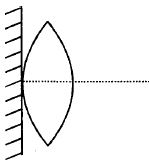
A thin convex lens of focal length $'f'$ is put on a plane mirror as shown in the figure. When an object is kept at a distance $'a'$ from the lens - mirror combination, its image is formed at a distance $\frac{a}{3}$ in front of the combination. The value of $'a'$ is
Seven capacitors, each of the capacitance $2\,\mu F$, are to be connected in a configuration to obtain an effective capacitance of $\left( {\frac{6}{{13}}} \right)\,\mu F$. Which of the combinations, shown in figures below, will achieve the desired value ?
A convex lens of focal length $30 \ cm$ and a concave lens of $10\ cm$ focal length are placed so as to have the same axis. If a parallel beam of light falling on convex lens leaves concave lens as a parallel beam, then the distance between two lenses will be.......$cm$
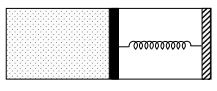
An ideal monoatomic gas is confined in a horizontal cylinder by a spring loaded piston (as shown in the figure). Initially the gas is at temperature $T _1$, pressure $P_1$ and volume $V_1$ and the spring is in its relaxed state. The gas is then heated very slowly to temperature $T_2$, pressure $P _2$ and volume $V _2$. During this process the piston moves out by a distance $x$. Ignoring the friction between the piston and the cylinder, the correct statement$(s)$ is(are)

$(A)$ If $V_2=2 V_1$ and $T_2=3 T_1$, then the energy stored in the spring is $\frac{1}{4} P_1 V_1$

$(B)$ If $V_2=2 V_1$ and $T_2=3 T_1$, then the change in internal energy is $3 P_1 V_1$

$(C)$ If $V_2=3 V_1$ and $T_2=4 T_1$, then the work done by the gas is $\frac{7}{3} P_1 V_1$

$(D)$ If $V_2=3 V_1$ and $T_2=4 T_1$, then the heat supplied to the gas is $\frac{17}{6} P_1 V_1$
If the length of the simple pendulum is increased by $44\%$, then what is the change in time period of pendulum ..... $\%$
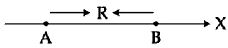
Two electric dipoles $A, B$ with respective dipole moments $\overrightarrow {{d_A}}  =  - 4\,qa\,\hat i$ and $\overrightarrow {{d_B}}  =  2\,qa\,\hat i$ are placed on the $x-$ axis with a separation $R$, as shown in the figure. The distance from $A$ at which both of them produce the same potential is
If two streams of protons move parallel to each other in the same direction, then they
In a car, a rear view mirror having a radius of curvature $1.50\, m$ forms a virtual image of a bus located $10.0 \,m$ from the mirror. The factor by which the mirror magnifies the size of the bus is close to