If the length of the simple pendulum is increased by $44\%$, then what is the change in time period of pendulum ..... $\%$
Medium
Download our app for free and get started
(b) $T = 2\,\pi \sqrt {\frac{l}{g}} $
$ \Rightarrow \frac{{{T_2}}}{{{T_1}}} = \sqrt {\frac{{{l_2}}}{{{l_1}}}} $
$ = \sqrt {\frac{{144}}{{100}}} = \frac{{12}}{{10}}$
==> $T_2 = 1.2\, T_1$
Hence $\%$ increase $ = \frac{{{T_2} - {T_1}}}{{{T_1}}} \times 100 = 20\% $

Download our appand get started for free
Experience the future of education. Simply download our apps or reach out to us for more information. Let's shape the future of learning together!No signup needed.*
Similar Questions
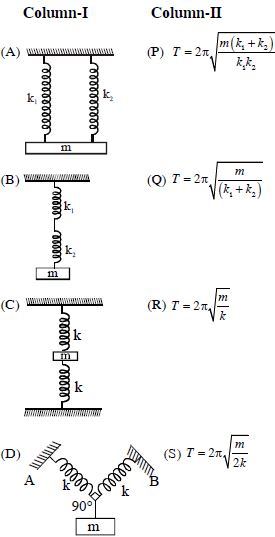
- 1In the following questions, match column $-I$ with column $-II$ and choose the correct optionsView Solution
- 2If the length of simple pendulum is increased by $300\%$, then the time period will be increased by ..... $\%$View Solution
- 3A particle performs simple harmonic motion with a period of $2$ second. The time taken by the particle to cover a displacement equal to half of its amplitude from the mean position is $\frac{1}{ a } s .$ The value of $'a'$ to the nearest integer is.........View Solution
- 4A particle executes simple harmonic motion with an amplitude of $4 \mathrm{~cm}$. At the mean position, velocity of the particle is $10 \mathrm{~cm} / \mathrm{s}$. The distance of the particle from the mean position when its speed becomes $5 \mathrm{~cm} / \mathrm{s}$ is $\sqrt{\alpha} \mathrm{cm}$, where $\alpha=$____________.View Solution
- 5The angular amplitude of a simple pendulum is $\theta_0$. The maximum tension in its string will beView Solution
- 6A particle is doing simple harmonic motion of amplitude $0.06 \mathrm{~m}$ and time period $3.14 \mathrm{~s}$. The maximum velocity of the particle is. . . . .. . $\mathrm{cm} / \mathrm{s}$.View Solution
- 7View SolutionTo make the frequency double of an oscillator, we have to
- 8The displacement of a particle along the $x-$ axis is given by $x=asin^2$$\omega t$ . The motion of the particle corresponds toView Solution
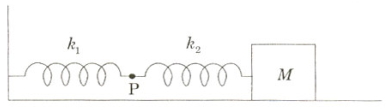
- 9The mass $M$ shown in the figure oscillates in simple harmonic motion with amplitude $A$. The amplitude of the point $P$ isView Solution
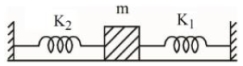
- 10A mass $m$ is attached to two springs as shown in figure. The spring constants of two springs are $K _1$ and $K _2$. For the frictionless surface, the time period of oscillation of mass $m$ isView Solution