MCQ
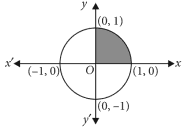
The area bounded by the curve $x^2+y^2=1$ in first quadrant is
  • $\frac{\pi}{4}$ sq. units
  • B
    $\frac{\pi}{2}$ sq. units
  • C
    $\frac{\pi}{3}$ sq. units
  • D
    $\frac{\pi}{6}$ sq. units

Answer

Correct option: A.
$\frac{\pi}{4}$ sq. units
(a): We have, $x^2+y^2=1$, which is a circle with centre $(0,0)$ and radius $=1$.
Image
Required area
$
\begin{array}{l}
=\int_0^1 \sqrt{1-x^2} d x \\
=\left[\frac{x}{2} \sqrt{1-x^2}+\frac{1}{2} \sin ^{-1} \frac{x}{1}\right]_0^1 \\
=\left[\frac{1}{2} \sin ^{-1} 1\right]=\left(\frac{1}{2} \times \frac{\pi}{2}\right)=\frac{\pi}{4} \text { sq. units }
\end{array}
$

Need a full question paper?

Generate a complete, print-ready paper with questions like this in minutes — across 16+ boards, with answer keys.

Start Generating Free

Similar questions

Let a unit vector which makes an angle of $60^{\circ}$ with $2 \hat{i}+2 \hat{j}-\hat{k}$ and an angle of $45^{\circ}$ with $\hat{i}-\hat{k}$ be $\overrightarrow{\mathrm{C}}$. Then $\overrightarrow{\mathrm{C}}+\left(-\frac{1}{2} \hat{\mathrm{i}}+\frac{1}{3 \sqrt{2}} \hat{\mathrm{j}}-\frac{\sqrt{2}}{3} \hat{\mathrm{k}}\right)$ is :
The solution of the differential equation $(1 + {x^2})\frac{{dy}}{{dx}} = x(1 + {y^2})$ is
Let $y=y(x)$ be the solution of the differential equations $\frac{d y}{d x}+\frac{5}{x\left(x^5+1\right)} y=\frac{\left(x^5+1\right)^2}{x^7}, x > 0$. If $y(1)=2$, then $y(2)$ is equal to
For, $\alpha, \beta, \gamma, \delta \in N$, if

$\int\left(\left(\frac{x}{e}\right)^{2 x}+\left(\frac{e}{x}\right)^{2 x}\right) \log _{ e } x d x=\frac{1}{\alpha}\left(\frac{ x }{ e }\right)^{\beta x}-\frac{1}{\gamma}\left(\frac{ e }{ x }\right)^{\delta x }+ C ,$

Where $e =\sum \limits_{ n =0}^{\infty} \frac{1}{ n !}$ and $C$ is constant of integration, then $\alpha+2 \beta+3 \gamma-4 \delta$ is equal to:

The differential coefficient of ${\cos ^{ - 1}}\left\{ {\sqrt {{{1 + x} \over 2}} } \right\}$ with respect to $x$ is
If $\vec{\text{a}}$ be the position vector whose tip is (5, -3) find the coordinates of a point B such that $\vec{\text{AB}}=\vec{\text{a}}$ the coordinates of A being (4, -1):
  1. (9, -4)
  2. (-9, -4)
  3. (9, 4)
  4. None of these
The probability that a leap year will have 53 sundays is:
  1. $\frac17$
  2. $\frac27$
  3. $\frac57$
  4. $\frac67$
The function $\text{f(x)}=\frac{4-\text{x}^2}{4\text{x}-\text{x}^3}$
  1. Discontinuous at only one point.
  2. Discontinuous exactly at two points.
  3. Discontinuous exactly at three points.
  4. None of these.
Let $f: R_{+} \rightarrow[-5, \infty)$ be defined as $f(x)=9 x^2+6 x-5$, where $R_{+}$is the set of all non-negative real numbers. Then, $f$ is :
A man is known to speak the truth $3$ out of $4$ times. He throws a die and reports that it is a six. The probability that it is actually a six, is