MCQ 11 Mark
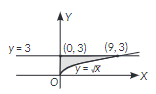
The area bounded by the curve $y=\sqrt{x}, Y$-axis and between the lines $y=0$ and $y=3$ is
View full question & answer→MCQ 21 Mark
Shown below is the curve defined by the equation $y=\log (x+1)$ for $x \geq 0$.
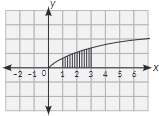
Which of these is the area of the shaded region? - ✓
$6 \log (2)-2$
- B
$6 \log (2)-6$
- C
$6 \log (2)$
- D
$5 \log (2)$
AnswerCorrect option: A. $6 \log (2)-2$
$6 \log (2)-2$
View full question & answer→MCQ 31 Mark
The area enclosed by the curve $\frac{x^2}{25}+\frac{y^2}{9}=1$ is
- A
$10 \pi$ sq. units
- ✓
$15 \pi$ sq. units
- C
$5 \pi$ sq. units
- D
$4 \pi$ sq. units
AnswerCorrect option: B. $15 \pi$ sq. units
(b) : We have $\frac{x^2}{25}+\frac{y^2}{9}=1$, which is an ellipse Here, $a=5$ and $b=3$
Since, area of region bounded by the ellipse $\frac{x^2}{a^2}+\frac{y^2}{b^2}=1$ is $\pi a b$.
$\therefore \quad$ Required area $=\pi(5)(3)=15 \pi$ sq. units
View full question & answer→MCQ 41 Mark
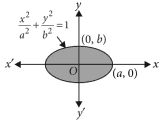
Area of the ellipse $\frac{x^2}{a^2}+\frac{y^2}{b^2}=1$ is
AnswerCorrect option: C. $\pi a b$ sq. units
(c) : Total area, $A=4 \times$ Area in first quadrant
$
\begin{array}{l}
=4 \times \int_0^a y d x=4 \int_0^a \frac{b}{a} \sqrt{a^2-x^2} d x \\
=\frac{4 b}{a}\left[\frac{x}{2} \sqrt{a^2-x^2}+\frac{a^2}{2} \sin ^{-1} \frac{x}{a}\right]_0^a \\
=\pi a b \text { sq. units }
\end{array}
$ View full question & answer→MCQ 51 Mark
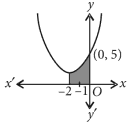
The area $S$ is bounded by the curve $y=x^2+4 x+5$, the axes of coordinates and minimum ordinate. Which of these is the value of $S$ ?
- A
$3 \frac{2}{3}$ sq. units
- ✓
$4 \frac{2}{3}$ sq. units
- C
$5 \frac{2}{3}$ sq. units
- D
$6 \frac{2}{3}$ sq. units
AnswerCorrect option: B. $4 \frac{2}{3}$ sq. units
(b) : We have, $y=x^2+4 x+5=(x+2)^2+1$
$
\begin{array}{l}
\therefore \quad \text { Required area }=\int_{-2}^0\left(x^2+4 x+5\right) d x \\
=\left[\frac{x^3}{3}+2 x^2+5 x\right]_{-2}^0 \\
=-\left[-\frac{8}{3}+8-10\right] \\
=2+\frac{8}{3}=\frac{14}{3}=4 \frac{2}{3} \text { sq. units }
\end{array}
$ View full question & answer→MCQ 61 Mark
Area enclosed by the circle $x^2+y^2=a^2$ is equal to
- A
$2 \pi a^2$ sq. units
- ✓
$\pi a^2$ sq. units
- C
$2 \pi a$ sq. units
- D
$\pi a$ sq. units
AnswerCorrect option: B. $\pi a^2$ sq. units
(b) : We have, $x^2+y^2=a^2$, which is a circle with centre $(0,0)$ and radius $a$.
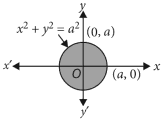
$\therefore \quad$ Required area $=4 \times$ Area in the first quadrant
$
\begin{array}{l}
=4 \int_0^a \sqrt{a^2-x^2} d x \\
=4\left[\frac{x}{2} \sqrt{a^2-x^2}+\frac{a^2}{2} \sin ^{-1} \frac{x}{a}\right]_0^a \\
=4\left(\frac{a^2}{2}\right) \frac{\pi}{2}=\pi a^2 \text { sq. units }
\end{array}
$ View full question & answer→MCQ 71 Mark
If the area bounded by the curve $2 x^2+y^2=2$ is $A$. Then which of the following is the value of $A$ ?
AnswerCorrect option: B. $\sqrt{2} \pi$ sq. units
(b) : We have, $2 x^2+y^2=2$
$\Rightarrow \quad \frac{x^2}{1}+\frac{y^2}{2}=1$, which is an ellipse.
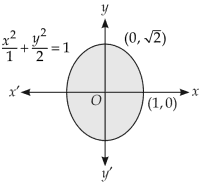
Here, $a=1$ and $b=\sqrt{2}$
$\because \quad$ Area bounded by the ellipse $\frac{x^2}{a^2}+\frac{y^2}{b^2}=1$ is $\pi a b$ sq. units
$\therefore \quad$ Required area $=\pi \sqrt{2}$ sq. units. View full question & answer→MCQ 81 Mark
Which of these is equal to the area enclosed between the curve $x^2+y^2=16$ and the coordinate axes in the first quadrant?
- ✓
$4 \pi$ sq. units
- B
$3 \pi$ sq. units
- C
$2 \pi$ sq. units
- D
$\pi$ sq. units
AnswerCorrect option: A. $4 \pi$ sq. units
(a) : Given curve is a circle with centre $(0,0)$ and radius 4 .
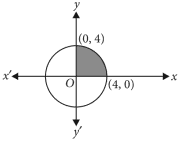
$\therefore \quad$ Required area
$
=\int_0^4 \sqrt{16-x^2} d x
$
$=\left[\frac{x}{2} \sqrt{16-x^2}+\frac{16}{2} \sin ^{-1} \frac{x}{4}\right]_0^4=4 \pi$ sq. units View full question & answer→MCQ 91 Mark
Area of the region bounded by the curve $y=\cos x$ between $x=0$ and $x=\pi$ is
Answer(a): We have, $y=\cos x$
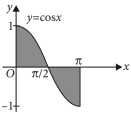
$\therefore \quad$ Required area
$
=2 \int_0^{\pi / 2} \cos x d x=2[\sin x]_0^{\pi / 2}=2 \text { sq. units }
$ View full question & answer→MCQ 101 Mark
The area bounded by the $x$-axis, the curve $y=f(x)$ and the lines $x=1, x=b$ is equal to $\sqrt{b^2+1}-\sqrt{2}$ for all $b>1$. Which of the following can be $f(x)$ ?
- A
$\sqrt{x-1}$
- B
$\sqrt{x+1}$
- C
$\sqrt{x^2+1}$
- ✓
$x / \sqrt{x^2+1}$
AnswerCorrect option: D. $x / \sqrt{x^2+1}$
(d) : We have, $\int_1^b f(x) d x=\sqrt{b^2+1}-\sqrt{2}$ On differentiating w.r.t. $b$, we get
$
f(b)=\frac{2 b}{2 \sqrt{b^2+1}} \Rightarrow f(x)=\frac{x}{\sqrt{x^2+1}}
$
View full question & answer→MCQ 111 Mark
The area bounded by the curve $x^2=4 y+4$ and line $3 x+4 y=0$ is
- A
$\frac{25}{4}$ sq. units
- B
$\frac{125}{8} sq$. units
- C
$\frac{125}{16}$ sq. units
- ✓
$\frac{125}{24}$ sq. units
AnswerCorrect option: D. $\frac{125}{24}$ sq. units
(d): We have, $x^2=4 y+4$ ...(i)
and $3 x+4 y=0$ ...(ii)
Solving (i) and (ii), we get $x=-4,1$
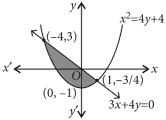
$\therefore \quad$ Required area
$
=\int_{-4}^1\left(-\frac{3 x}{4}-\frac{x^2}{4}+1\right) d x=\left[-\frac{3}{8} x^2-\frac{x^3}{12}+x\right]_{-4}^1
$
$=-\frac{3}{8}(1-16)-\frac{1}{12}(1+64)+5=\frac{45}{8}-\frac{5}{12}=\frac{125}{24}$ sq. units View full question & answer→MCQ 121 Mark
The area bounded by the curve $y=\sec ^2 x, y=0$ and $|x|=\frac{\pi}{3}$ is
- A
$\sqrt{3}$ sq. units
- B
$\sqrt{2}$ sq. units
- ✓
$2 \sqrt{3}$ sq. units
- D
AnswerCorrect option: C. $2 \sqrt{3}$ sq. units
(c): We have, $y=\sec ^2 x$ and $y=0$ and $x=\frac{\pi}{3},-\frac{\pi}{3}$
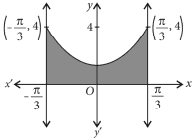
$\therefore \quad$ Required area
$
=\int_{-\pi / 3}^{\pi / 3} \sec ^2 x d x=[\tan x]_{-\pi / 3}^{\pi / 3}=2 \sqrt{3} \text { sq. units }
$ View full question & answer→MCQ 131 Mark
Area of the region bounded by the curve $y=\tan x$, line $x=\frac{\pi}{4}$ and the $x$-axis is
AnswerCorrect option: B. $\frac{1}{2} \log 2$ sq. units
(b) : We have, $y=\tan x$ and $x=\frac{\pi}{4}$
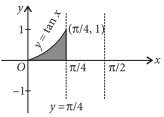
$\therefore \quad$ Required area
$
\begin{array}{l}
=\int_0^{\pi / 4} \tan x d x=[-\log |\cos x|]_0^{\pi / 4}=-\log \frac{1}{\sqrt{2}}+\log 1 \\
=\log \sqrt{2}=\frac{1}{2} \log 2 \text { sq. units }
\end{array}
$ View full question & answer→MCQ 141 Mark
Area bounded by the curve $y=\cos x$ between $x=0$ and $x=\frac{3 \pi}{2}$ is
Answer(c): We have, $y=\cos x$, whose graph is shown below, between $x=0$ and $x=\frac{3 \pi}{2}$
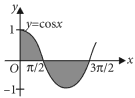
$\therefore \quad$ Required area
$
\begin{array}{l}
=\int_0^{\pi / 2} \cos x d x+\left|\int_{\pi / 2}^{3 \pi / 2} \cos x d x\right| \\
=[\sin x]_0^{\pi / 2}+\left|[\sin x]_{\pi / 2}^{3 \pi / 2}\right| \\
=1+|(-1-1)|=1+2=3 \text { sq. units }
\end{array}
$ View full question & answer→MCQ 151 Mark
The area of the region bounded by parabola $y^2=x$ and the straight line $2 y=x$ is
- ✓
$\frac{4}{3}$ sq. units
- B
- C
$\frac{2}{3}$ sq. unit
- D
$\frac{1}{3}$ sq. unit
AnswerCorrect option: A. $\frac{4}{3}$ sq. units
(a) : We have $2 y=x \ldots$ (i), a straight line, and $y^2=x$...(ii), a parabola with vertex $(0,0)$.
Solving (i) and (ii), we get $x=0$ and $x=4$.
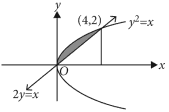
$\therefore \quad$ Required area
$
\begin{array}{l}
=\int_0^4\left(\sqrt{x}-\frac{x}{2}\right) d x=\left[\frac{2}{3} x^{3 / 2}-\frac{x^2}{4}\right]_0^4=\frac{2}{3} \times 8-\frac{16}{4} \\
=\frac{16-12}{3}=\frac{4}{3} \text { sq. units }
\end{array}
$ View full question & answer→MCQ 161 Mark
Area bounded by the ellipse $\frac{x^2}{4}+\frac{y^2}{9}=1$ is
- ✓
$6 \pi$ sq. units
- B
$3 \pi$ sq. units
- C
$12 \pi$ sq. units
- D
AnswerCorrect option: A. $6 \pi$ sq. units
(a) : Here $a^2=4$ and $b^2=9$.
Since, area of ellipse $\frac{x^2}{a^2}+\frac{y^2}{b^2}=1$ is $\pi a b$ sq. units.
$\therefore \quad$ Required area $=\pi \times 2 \times 3=6 \pi$ sq. units.
View full question & answer→MCQ 171 Mark
Which of these is equal to the area lying between the parabola $y^2=4 x$ and its latus rectum?
- A
$\frac{1}{3}$ sq. units
- B
$\frac{2}{3}$ sq. units
- C
$\frac{5}{3}$ sq. units
- ✓
$\frac{8}{3}$ sq. units
AnswerCorrect option: D. $\frac{8}{3}$ sq. units
(d) : We know that the area of region bounded by the parabola $y^2=4 a x$ and its latus rectum is $\frac{8}{3} a^2$ sq. units.
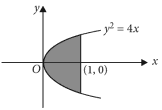
Here, $a=1$, therefore required area $=\frac{8}{3}$ sq. units View full question & answer→MCQ 181 Mark
The area of the region bounded by the ellipse $\frac{x^2}{25}+\frac{y^2}{16}=1$ is
- ✓
$20 \pi$ sq. units
- B
$20 \pi^2$ sq. units
- C
$16 \pi^2$ sq. units
- D
$25 \pi$ sq. units
AnswerCorrect option: A. $20 \pi$ sq. units
(a) : Area of the region bounded by the ellipse $\frac{x^2}{a^2}+\frac{y^2}{b^2}=1$ is $\pi a b$ sq. units
$\therefore \quad$ Required area $=\pi \times 5 \times 4=20 \pi$ sq. units
View full question & answer→MCQ 191 Mark
The area of the region bounded by the curve $y=\sin x$ between the ordinates $x=0, x=\frac{\pi}{2}$ and the $x$-axis is
Answer(d): We have, $y=\sin x, 0 \leq x \leq \frac{\pi}{2}$
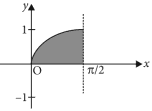
$\therefore \quad$ Required area
$
=\int_0^{\pi / 2} \sin x d x=[-\cos x]_0^{\pi / 2}=-[0-1]=1 \text { sq. unit }
$ View full question & answer→MCQ 201 Mark
Find the area of the ellipse $\frac{x^2}{4^2}+\frac{y^2}{9^2}$.
- A
$16 \pi$ sq. unit
- B
$2 \pi$ sq. units
- ✓
$36 \pi$ sq. units
- D
$4 \pi$ sq. units
AnswerCorrect option: C. $36 \pi$ sq. units
(c) : Since, area of theellipse $\frac{x^2}{a^2}+\frac{y^2}{b^2}=1$ is $\pi a b$ sq. units.
$\therefore \quad$ Required area $=\pi \times 4 \times 9=36 \pi$ sq. units.
View full question & answer→MCQ 211 Mark
The area enclosed between the curve $y^2=4 x$ and the line $y=x$ is
- ✓
$\frac{8}{3}$ sq. units
- B
$\frac{4}{3}$ sq. units
- C
$\frac{2}{3}$ sq. units
- D
$\frac{1}{2}$ sq. units
AnswerCorrect option: A. $\frac{8}{3}$ sq. units
(a) : We have, $y^2=4 x$ ...(i)
and $y=x$ ...(ii)
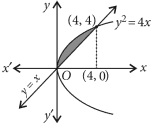
$\therefore \quad$ Required area
$
\begin{array}{l}
=\int_0^4(\sqrt{4 x}-x) d x=\int_0^4\left(2 x^{1 / 2}-x\right) d x \\
=\left[2 \frac{x^{3 / 2}}{3 / 2}-\frac{x^2}{2}\right]_0^4=\frac{4}{3}\left(4^{3 / 2}\right)-\frac{4^2}{2} \\
=\frac{32}{3}-8=\frac{8}{3} \text { sq. units }
\end{array}
$ View full question & answer→MCQ 221 Mark
The area bounded by the curve $y=f(x)$, the $x$-axis and $x=1$ and $x=b$ is $(b-1) \sin (3 b+4)$. Which of the following can be $f(x)$ ?
AnswerCorrect option: C. $\sin (3 x+4)+3(x-1) \cdot \cos (3 x+4)$
(c) : Given, $\int_1^b f(x) d x=(b-1) \sin (3 b+4)$
Area function $=\int_1^x f(x) d x=(x-1) \sin (3 x+4)$
On differentiating, we get
$
f(x)=\sin (3 x+4)+3(x-1) \cdot \cos (3 x+4)
$
View full question & answer→MCQ 231 Mark
The area bounded by the curve $x^2+y^2=1$ in first quadrant is
- ✓
$\frac{\pi}{4}$ sq. units
- B
$\frac{\pi}{2}$ sq. units
- C
$\frac{\pi}{3}$ sq. units
- D
$\frac{\pi}{6}$ sq. units
AnswerCorrect option: A. $\frac{\pi}{4}$ sq. units
(a): We have, $x^2+y^2=1$, which is a circle with centre $(0,0)$ and radius $=1$.
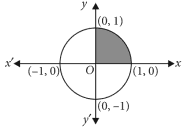
Required area
$
\begin{array}{l}
=\int_0^1 \sqrt{1-x^2} d x \\
=\left[\frac{x}{2} \sqrt{1-x^2}+\frac{1}{2} \sin ^{-1} \frac{x}{1}\right]_0^1 \\
=\left[\frac{1}{2} \sin ^{-1} 1\right]=\left(\frac{1}{2} \times \frac{\pi}{2}\right)=\frac{\pi}{4} \text { sq. units }
\end{array}
$ View full question & answer→MCQ 241 Mark
Find the area enclosed by the parabola $y^2=x$ and the line $y+x=2$ and the $x$-axis.
- A
$\frac{5}{6}$ sq. units
- ✓
$\frac{7}{6}$ sq. units
- C
$\frac{6}{7} sq$. units
- D
$\frac{4}{7}$ sq. units
AnswerCorrect option: B. $\frac{7}{6}$ sq. units
(b) : The given line and parabola meet at the points $(1,1)$ and $(4,-2)$.
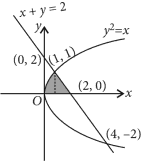
$\therefore \quad$ Required area
$
\begin{array}{l}
=\int_0^1 \sqrt{x} d x+\int_1^2(2-x) d x \\
=\left[\frac{x^{3 / 2}}{3 / 2}\right]_0^1+\left[2 x-\frac{x^2}{2}\right]_1^2 \\
=\frac{2}{3}(1-0)+\left(2 \times 2-\frac{2^2}{2}\right)-\left(2-\frac{1}{2}\right)
\end{array}
$
$=\frac{2}{3}+2-\frac{3}{2}=\frac{4+12-9}{6}=\frac{7}{6}$ sq. units View full question & answer→MCQ 251 Mark
The area bounded by the curve $y^2=x$, line $y=4$ and $y$-axis is
- A
$\frac{16}{3}$ sq. units
- ✓
$\frac{64}{3}$ sq. units
- C
$7 \sqrt{2}$ sq. units
- D
AnswerCorrect option: B. $\frac{64}{3}$ sq. units
(b) : We have, $y^2=x$ , which is a parabola with vertex $(0,0)$ and line $y=4$
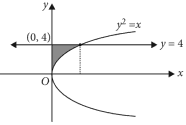
$\therefore \quad$ Required area
$
\begin{array}{l}
=\int_0^4 y^2 d y \\
=\left[\frac{y^3}{3}\right]_0^4=\frac{64}{3} \text { sq. units }
\end{array}
$ View full question & answer→MCQ 261 Mark
Area of the region bounded by the curve $y=x^2$ and the line $y=4$ is
- A
$\frac{11}{3}$ sq. units
- ✓
$\frac{32}{3}$ sq. units
- C
$\frac{43}{3}$ sq. units
- D
$\frac{47}{3} sq$. units
AnswerCorrect option: B. $\frac{32}{3}$ sq. units
(b) : We have, $y=x^2$
and $y=4$
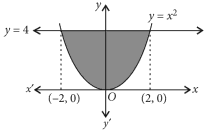
$\therefore \quad$ Required area
$=2 \int_0^2\left(4-x^2\right) d x=\left[2\left(4 x-\frac{x^3}{3}\right)\right]_0^2=\frac{32}{3}$ sq. units View full question & answer→MCQ 271 Mark
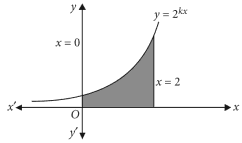
Find the area above $x$-axis, bounded by the curves $y=2^{k x}, x=0$ and $x=2$.
- ✓
$\frac{4^k-1}{k \log _e 2}$
- B
$\frac{2^k-1}{2 \log _e 2}$
- C
$\frac{3-k}{k \log _e 2}$
- D
$\frac{-1+3^k}{2 \log _e 2}$
AnswerCorrect option: A. $\frac{4^k-1}{k \log _e 2}$
(a) : Required area $=\int_0^2 y d x$
$
=\int_0^2 2^{k x} d x=\left[\frac{2^{k x}}{k \log _e 2}\right]_0^2=\frac{2^{2 k}}{k \log _e 2}-\frac{1}{k \log _e 2}=\frac{4^k-1}{k \log _e 2}
$ View full question & answer→MCQ 281 Mark
The area bounded by the curve $x=3 y^2-9$ and the line $x=0, y=0$ and $y=1$ is
- ✓
- B
$8 / 3 sq$. units
- C
$3 / 8$ sq. unit
- D
Answer(a) : We have, $x=3 y^2-9$
$
\Rightarrow 3 y^2=x+9
$
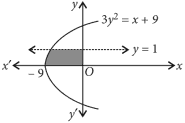
$\therefore \quad$ Required area
$
=\left|\int_0^1\left(3 y^2-9\right) d y\right|=\left|\left[y^3-9 y\right]_0^1\right|=|1-9|=8 \text { sq. units }
$ View full question & answer→MCQ 291 Mark
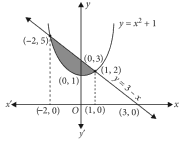
The area of the region bounded by the parabola $y=x^2+1$ and the straight line $x+y=3$ is given by
- A
$\frac{45}{7}$ sq. units
- B
$\frac{25}{4}$ sq. units
- C
$\frac{5}{18}$ sq. units
- ✓
$\frac{9}{2}$ sq. units
AnswerCorrect option: D. $\frac{9}{2}$ sq. units
(d) : We have, $y=x^2+1$ ...(i)
and $x+y=3$ ...(ii)
Solving (i) and (ii), we get
$
\begin{array}{l}
x^2+x-2=0 \Rightarrow x=-2,1 \\
\therefore \quad \text { Required area } \\
=\int_{-2}^1\left\{3-x-\left(x^2+1\right)\right\} d x \\
=\left[2 x-\frac{x^2}{2}-\frac{x^3}{3}\right]_{-2}^1 \\
=\left(2-\frac{1}{2}-\frac{1}{3}\right)-\left(-4-2+\frac{8}{3}\right)=\frac{9}{2} \text { sq. units }
\end{array}
$ View full question & answer→