MCQ
The area under acceleration-time graph gives
  • A
    Distance travelled
  • B
    Change in acceleration
  • C
    Force acting
  • Change in velocity

Answer

Correct option: D.
Change in velocity
d
(d)Acceleration$-$Time graph represents the object's change in velocity. Acceleration $=\frac{\Delta v}{\Delta t}$

Area between acceleration-time graph gives$:$

$a \times \Delta t=\frac{\Delta v}{\Delta t} \times \Delta t=\Delta v$

Need a full question paper?

Generate a complete, print-ready paper with questions like this in minutes — across 16+ boards, with answer keys.
Start Generating Free

Similar questions

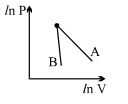
The figure, shows the graph of logarithmic reading of pressure and volume for two ideal gases $A$ and $B$ undergoing adiabatic process. From figure it can be concluded that
If the particle repeats its motion after a fixed time interval of $8 \,s$ then after how much time its maximum value of $PE$ will be attained after attaining its minimum value is ........... $s$
A spherical soap bubble of radius $3\,cm$ is formed inside another spherical soap bubble of radius $6\,cm$. If the internal pressure of the smaller bubble of radius $3\,cm$ in the above system is equal to the internal pressure of the another single soap bubble of radius $r\,cm$. The value of $r$ is.......
Unit of self inductance is
The workdone by a gas molecule in an isolated system is given by, $W =\alpha \beta^{2} e ^{-\frac{ x ^{2}}{\alpha kT }},$ where $x$ is the displacement, $k$ is the Boltzmann constant and $T$ is the temperature, $\alpha$ and $\beta$ are constants. Then the dimension of $\beta$ will be
A large horizontal surface moves up and down in $S.H.M.$ with an amplitude of $1\, cm$. If a mass of $10\, kg$ (which is placed on the surface is to remain continuously in contact with it, the maximum frequency of $S.H.M.$ will be .... $Hz$
The two gases with the ratio 3 : 2 of their masses in a container are at a temperature T. The ratio of the kinetic energies of the molecule of two gases is:
If density of a planet is double that of the earth and the radius $1.5$ times that of the earth, the acceleration due to gravity on the surface of the planet is ........
When water is heated from $0$ to $4\,^oC$
Consider a ring rolling down a smooth inclined plane of vertical height 'h' and inclination $\theta$. Then the true statement in the following is?