MCQ
The area under the velocity time graph between any two instants $t = t_1$ and $t = t_2$ gives the distance covered in a time $\Delta\text{t}=\text{t}_2-\text{t}_1:$
  • A
    Only if the particle moves with a uniform acceleration.
  • B
    Only if the particle moves with a uniform velocity.
  • C
    Only if the particle moves with an acceleration increasing at a uniform rate.
  • In all cases irrespective of whether the motion is one of uniform velocity, or of uniform acceleration or of variable acceleration.
Answer

Correct option: D.
In all cases irrespective of whether the motion is one of uniform velocity, or of uniform acceleration or of variable acceleration.
$d.$ In all cases irrespective of whether the motion is one of uniform velocity, or of uniform acceleration or of variable acceleration.

Need a full question paper?

Generate a complete, print-ready paper with questions like this in minutes — across 16+ boards, with answer keys.

Start Generating Free

Similar questions

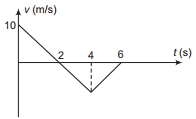
For the velocity-time graph shown in the figure, in a time interval from $t=0$ to $t=6\,s$, match the following columns.
Colum $I$ Colum $II$
$(A)$ Change in velocity $(p)$ $-5 / 3\,Sl$ unit
$(B)$ Average acceleration $(q)$ $-20\,SI$ unit
$(C)$ Total displacement $(r)$ $-10\,SI$ unit
$(D)$ Acceleration at $t=3\,s$ $(s)$ $-5\,SI$ unit

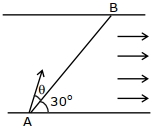
A swimmer wants to cross a river from point $A$ to point $B$. Line $A B$ makes an angle of $30^{\circ}$ with the flow of river. Magnitude of velocity of the swimmer is same as that of the river. The angle $\theta$ with the line ${AB}$ should be $^{\circ}$, so that the swimmer reaches point ${B}$.
A body is revolving with a constant speed along a circle. If its direction of motion is reversed but the speed remains the same, then which of the following statement is true
Young's modulus of elasticity $Y$ is expressed in terms of three derived quantities, namely, the gravitational constant $G$, Planck's constant $h$ and the speed of light $c$, as $Y=c^\alpha h^\beta G^\gamma$. Which of the following is the correct option?
The escape velocity of a body from earth is about $11.2 \,km / s$. Assuming the mass and radius of the earth to be about $81$ and $4$ times the mass and radius of the moon, the escape velocity in $km / s$ from the surface of the moon will be .......
An inelastic ball is dropped from a height of $100\, m$. Due to earth$20\%$ of its energy is lost. To what height the ball will rise ......... $m$
One end of a uniform wire of length $L$ and of weight $W$ is attached rigidly to a point in the roof and weight $W_1$ is suspended from the lower end. If $S$ is the area of cross$-$section of the wire, the stress in the wire at a height $\frac{3}{4}$ from its lower end is;
An observer finds the magnitudes of the acceleration of two bodies to be the same. This necessary implies that the two bodies.
A body of mass $m$ is thrown upwards at an angle $\theta$ with the horizontal with velocity $v$. While rising up the velocity of the mass after $ t$ seconds will be
A hole is drilled in a copper sheet. The diameter of hole is $4.24 \,cm$ at $27.0^{\circ} C$. Diameter of the hole when it is heated to $35^{\circ} C$ is ...........