MCQ
The arrangement as shown in figure is called as
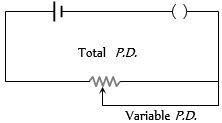
  • Potential divider
  • B
    Potential adder
  • C
    Potential substracter
  • D
    Potential multiplier

Answer

Correct option: A.
Potential divider
a
The arrangement as shown in figure is called as Potential divider.

Need a full question paper?

Generate a complete, print-ready paper with questions like this in minutes — across 16+ boards, with answer keys.

Start Generating Free

Similar questions

In general in an alternating current circuit
The magnification of an object placed in front of a convex lens of focal length $20\, cm$ is $+2$. To obtain a magnification of $-2$, the object has to be moved a distance equal to.....$cm$
A thin metal plate P is inserted half way between the plates of a parallel plate capacitor of capacitance C in such a way that it is parallel to the two plates. The capacitance now becomes
An electron falls from rest through a vertical distance h in a uniform and vertically upward directed electric field E. The direction of electric field is now reversed, keeping its magnitude the same. A proton is allowed to fall from rest in it through the same vertical distance h. The time of fall of the electron, in comparison to the time of fall of the proton is:
X-rays when incident on a meta
An a.c. supply of $100$ volts is applied to a capacitor of capacitance $20 \mu F$. If the current in the circuit is $0.628$ A, the frequency of $a.c.$ must be. 
A current $i$ $ampere$ flows along an infinitely long straight thin walled tube, then the magnetic induction at any point inside the tube is
A parallel plate capacitor is charged and then disconnected from the source steady $E.M.F.$ The plates are then drawn apart farther. Again it is connected to the same source. Then :
In a Millikan's oil drop experiment the charge on an oil drop is calculated to be $6.35 \times {10^{ - 19}}C$. The number of excess electrons on the drop is
Which experiment seemed to make it clear that light propogates as a wave?