MCQ
The average acceleration in one time period in a simple harmonic motion is:
  • A
    $\text{A}\omega^2$
  • B
    $\frac{\text{A}\omega^2}{2}$
  • C
    $\frac{\text{A}\omega^2}{\sqrt{2}}$
  • $\text{Zero}.$

Answer

Correct option: D.
$\text{Zero}.$
The acceleration changes its direction (to opposite direction) after every half oscillation. Thus, net acceleration is given as,
$\text{A}\omega^2+(-\text{A}\omega^2)=0$

Need a full question paper?

Generate a complete, print-ready paper with questions like this in minutes — across 16+ boards, with answer keys.

Start Generating Free

Similar questions

A block slides down a smooth inclined plane when released from the top, while another falls freely from the same point
A travelling microscope has $20$ divisions per $cm$ on the main scale while its Vernier scale has total $50$ divisions and $25$ Vernier scale divisions are equal to $24$ main scale divisions, what is the least count of the travelling microscope $..........\,cm$
If a body looses half of its velocity on penetrating $3 \,cm$ in a wooden block, then how much will it penetrate more before coming to rest ........... $cm$
The weight of sphere in air is $50\ g$. Its weight $40\  g$ in a liquid, at temperature $20\,^o C$. When  temperature increases to $70\,^o C$ , it weight becomes $45\  g$, then the ratio of densities of liquid at given two temperature is
A source of sound is moving with constant velocity of $20\, m/s$ emitting a note of frequency $1000 \,Hz.$ The ratio of frequencies observed by a stationary observer while the source is approaching him and after it crosses him will be

(Speed of sound $v = 340\, m/s$)

If the range of a gun which fires a shell with muzzle speed $V$ is $R$, then the angle of elevation of the gun is
A train moves from rest with a uniform acceleration $a$ . Attaining a maximum speed $v$ it  starts moving with uniform retardation $a$ . Assuming $s$ = total distance covered in the  unidirectional motion of the train, its total time of journey and maximum speed are  (respectively).
A leak proof cylinder of length $1 \;\mathrm{m},$ made of a metal which has very low coefficient of expansion is floating vertically in water at $0^{\circ} \mathrm{C}$ such that its height above the water surface is $20\; \mathrm{cm} .$ When the temperature of water is increased to $4^{\circ} \mathrm{C},$ the height of the cylinder above the water surface becomes $21 \;\mathrm{cm} .$ The density of water at $\mathrm{T}=4^{\circ} \mathrm{C},$ relative to the density at $\mathrm{T}=0^{\circ} \mathrm{C}$ is close to
A copper ball of mass $100\ gm$ is at a temperature $T$. It is dropped in a copper calorimeter of mass $100\ gm$, filled with $170\  gm$ of water at room temperature. Subsequently, the temperature of the system is found to be $75^o C$. $T$ is given by......$^oC$ (Given : room temperature $= 30^o  C$, specific heat of copper $=$ $0.1$ $cal/gm^o C$)
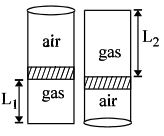
An ideal gas is trapped inside a test tube of cross-sectional area $20 \times 10^{-6} \,\,m^2$ as shown in the figure. The gas occupies a height $L_1$ at the bottom of the tube and is separated from air at atmospheric pressure by a mercury column of mass $0.002\,\, kg$. If the tube is quickly turned isothermally, upside down so that $L_2$ mercury column encloses the gas from below. The gas now occupies height $L_1$ in the tube. The ratio $L_1$ is [Take atmospheric pressure $= 10^5 Nm^{-2}]$