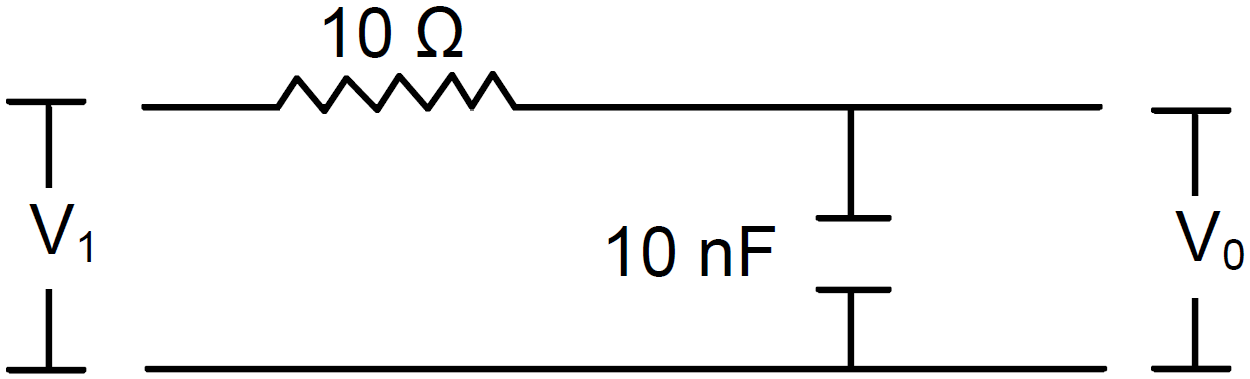
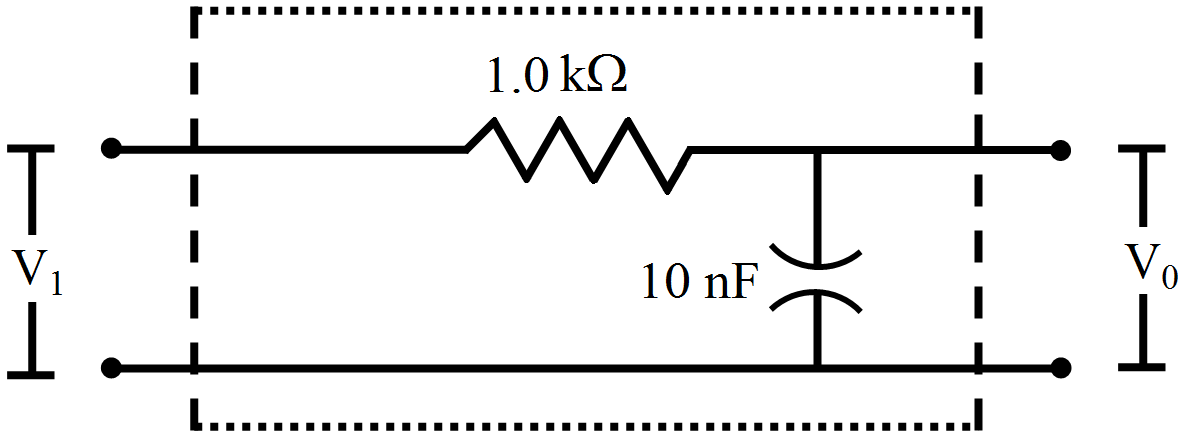
Figure shows a typical circuit for a low-pass filter. An AC input $V_{i }= 10mV$ is applied at the left end and the output $V_0$ is received at the right end. Find the output voltage for ν = 10kHz, 1.0MHz and 10.0MHz. Note that as the frequency is increased the output decreases and, hence, the name low-pass filter.
Download our app for free and get startedPlay store

$\text{V}_1=10\times10^{-3}\text{V}$ $\text{R}=1\times10^3\Omega$ $\text{C}=10\times10^{-9}\text{F}$
  1. $\text{X}_\text{C}=\frac{1}{\omega\text{C}}=\frac{1}{2\pi\text{fC}}$
$=\frac{1}{2\pi\times10\times10^3\times10\times10^{-9}}$
$=\frac{1}{2\pi\times10^{-4}}$
$=\frac{10^4}{2\pi}=\frac{5000}{\pi}$
$\text{Z}=\sqrt{\text{R}^2+\text{X}_\text{C}{^2}}$
$=\sqrt{\big(1\times10^3\big)^2+\Big(\frac{5000}{\pi}\Big)^2}$
$=\sqrt{10^6+\Big(\frac{5000}{\pi}\Big)^2}$
$\text{I}_0=\frac{\text{E}_0}{\text{Z}}=\frac{\text{V}_1}{\text{Z}}$
$=\frac{10\times10^{-3}}{\sqrt{10^6+\Big(\frac{5000}{\pi}\Big)^2}}$
  1. $\text{X}_\text{C}=\frac{1}{\omega\text{C}}=\frac{1}{2\pi\text{fC}}$
$=\frac{1}{2\pi\times10^5\times10\times10^{-9}}$
$=\frac{1}{2\pi\times10^{-3}}=\frac{10^3}{2\pi}=\frac{500}{\pi}$
$\text{Z}=\sqrt{\text{R}^2+\text{X}_\text{C}{^2}}$
$=\sqrt{\big(10^3\big)^{2}+\Big(\frac{500}{\pi}\Big)^2}$
$=\sqrt{10^6+\Big(\frac{500}{\pi}\Big)^2}$
$\text{I}_0=\frac{\text{E}_0}{\text{Z}}=\frac{\text{V}_1}{\text{Z}}$
$=\frac{10\times10^{-3}}{\sqrt{10^6+\Big(\frac{500}{\pi}\Big)^2}}$
$\text{V}_0=\text{I}_0\text{X}_\text{C}=\frac{10\times10^{-3}}{\sqrt{10^6+\Big(\frac{500}{\pi}\Big)^2}}\times\frac{500}{\pi}$
$=1.6124\text{V}\approx1.6\text{mV}$
  1. $\text{f}=1\text{MHz}=10^6\text{Hz}$
$\text{X}_\text{C}=\frac{1}{\omega\text{C}}=\frac{1}{2\pi\text{fC}}$
$=\frac{1}{2\pi\times10^6\times10\times10^{-9}}$
$=\frac{1}{2\pi\times10^{-2}}=\frac{10^2}{2\pi}=\frac{50}{\pi}$
$\text{Z}=\sqrt{\text{R}^2+\text{X}_\text{C}{^2}}$
$=\sqrt{\big(10^3\big)^{2}+\Big(\frac{50}{\pi}\Big)^2}$
$=\sqrt{10^6+\Big(\frac{50}{\pi}\Big)^2}$
$\text{I}_0=\frac{\text{E}_0}{\text{Z}}=\frac{\text{V}_1}{\text{Z}}$
$=\frac{10\times10^{-3}}{\sqrt{10^6+\Big(\frac{50}{\pi}\Big)^2}}$
$\text{V}_0=\text{I}_0\text{X}_\text{C}=\frac{10\times10^{-3}}{\sqrt{10^6+\Big(\frac{50}{\pi}\Big)^2}}\times\frac{50}{\pi}$
$\approx1.16\mu\text{V}$
  1. $\text{f}=10\text{MHz}=10^7\text{Hz}$
$\text{X}_\text{C}=\frac{1}{\omega\text{C}}=\frac{1}{2\pi\text{fC}}$
$=\frac{1}{2\pi\times10^7\times10\times10^{-9}}$
$=\frac{1}{2\pi\times10^{-1}}=\frac{10}{2\pi}=\frac{5}{\pi}$
$\text{Z}=\sqrt{\text{R}^2+\text{X}_\text{C}{^2}}$
$=\sqrt{\big(10^3\big)^{2}+\Big(\frac{5}{\pi}\Big)^2}$
$=\sqrt{10^6+\Big(\frac{5}{\pi}\Big)^2}$
$\text{I}_0=\frac{\text{E}_0}{\text{Z}}=\frac{\text{V}_1}{\text{Z}}$
$=\frac{10\times10^{-3}}{\sqrt{10^6+\Big(\frac{5}{\pi}\Big)^2}}$
$\text{V}_0=\text{I}_0\text{X}_\text{C}=\frac{10\times10^{-3}}{\sqrt{10^6+\Big(\frac{5}{\pi}\Big)^2}}\times\frac{5}{\pi}$
$\approx16\mu\text{V}$
art

Download our app
and get started for free

Experience the future of education. Simply download our apps or reach out to us for more information. Let's shape the future of learning together!No signup needed.*

Similar Questions

  • 1
    1. A screen is placed at a distance of 100 cm from an object. The image of the object is formed on the screen by a convex lens for two different locations of the lens separated by 20 cm. Calculate the focal length of the lens used.
    2. A converging lens is kept coaxially in contact with a diverging lens - both the lenses being of equal focal length. What is the focal length of the combination?
    View Solution
  • 2
    Define the electric resistivity of a conductor.
    Plot a graph showing the variation of resistivity with temperature in the case of a (a) conductor, (b) semiconductor.
    Briefly, explain, how the difference in the behaviour of the two can be explained in terms of number density of charge carriers and relaxation time.
    View Solution
  • 3
    Using truth tables of AND gate and NOT gate show that NAND gate is an AND gate followed by a NOT gate. Hence write the truth table of NAND gate.
    Why are NAND gates called ‘Universal Gates’?
    View Solution
  • 4
    1. Explain briefly the process of emission of light by a Light Emitting Diode (LED).
    2. Which semiconductors are preferred to make LEDs and why?
    3. Give two advantages of using LEDs over conventional incandescent lamps.
    View Solution
  • 5
    Answer the following:
    1. In what way is diffraction from each slit related to the interference pattern in a double slit experiment?
    2. When a tiny circular obstacle is placed in the path of light from a distant source, a bright spot is seen at the centre of the shadow of the obstacle. Explain, why.
    3. How does the resolving power of a microscope depend on (i) the wavelength of the light used and (ii) the medium used between the object and the objective lens?
    View Solution
  • 6
    A transformer has 50 turns in the primary and 100 in the secondary. If the primary is connected to a 220V DC supply, what will be the voltage across the secondary?
    View Solution
  • 7
    An AC voltage $V = V_m$​​​​​​​ is applied across a:
    1. Series RC circuit in which capacitive reactance is ‘a’ times the resistance in the circuit.
    2. Series RL circuit in which inductive reactance is ‘b’ times the resistance in the circuit.
    Find the value of power factor of the circuit in each case.
    View Solution
  • 8
    A resistor R and an inductor L are connected in series to a source $\text{V}=\text{V}_0\sin\omega\text{t}.$
    Find:
    1. Peak value of the voltage drops across R and across L,
    2. Phase difference between the applied voltage and current. Which of them is ahead?
    View Solution
  • 9
    In the given circuit, the value of resistance effect of the coil L is exactly equal to the resistance R. Bulbs $B_1$ and $B_2$ are exactly identical. Answer the following questions based on above information:
    1. Which one of the two bulbs lights up earlier, when key K is closed and why?
    2. What will be the comparative brightness of the two bulbs after sometime if the key K is kept closed and why?
    View Solution
  • 10
    State the principle of a cyclotron. Show that the time period of revolution of particles in a cyclotron is independent of their speeds. Why is this property necessary for the operation of a cyclotron?
    View Solution