MCQ
The average thermal energy for a mono$-$atomic gas is : $\left( k _{ B }\right.$ is Boltzmann constant and $T ,$ absolute $e$. temperature)
  • A
    $\frac{7}{2} k _{ B } T$
  • B
    $\frac{1}{2} k _{ B } T$
  • $\frac{3}{2} k _{ B } T$
  • D
    $\frac{5}{2} k_{B} T$

Answer

Correct option: C.
$\frac{3}{2} k _{ B } T$
c
Average thermal energy $=\frac{3}{2} K _{ B }\, T$

where $3$ is translational degree of freedom For monoatomic gas total degree of freedom

$f =3$ (translational degree of freedom)

Need a full question paper?

Generate a complete, print-ready paper with questions like this in minutes — across 16+ boards, with answer keys.
Start Generating Free

Similar questions

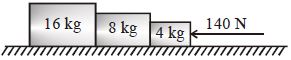
Three masses of $16, 8$ and $4\,kg$ are placed in contact as shown in figure. If a force of $140\,N$ is applied on $4\,kg$ mass, then the force on $16\,kg$ will be  ............ $ N$
In which thermodynamic process, volume remains same
The energy density in the electric field created by a point charge falls off with the distance from the point charge as:
The area of the acceleration-displacement curve of a body gives
The co-ordinates of a particle moving in $x-y$ plane are given by :  $\mathrm{x}=2+4 \mathrm{t}, \mathrm{y}=3 \mathrm{t}+8 \mathrm{t}^2 .$ The motion of the particle is :
$A$ block of mass $m$ is kept in an elevation which starts moving downward with an acceleration $a$ as shown in figure. The block is observed by two observers $A$ and $B$ for $a$ time interval $t_0$. According to the observer $A$
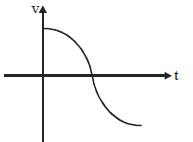
The graph shows the variation with time $t$ of velocity $v$ of an object moving along a straight line. $a-t$ graph will be
$Assertion :$ A transverse waves are produced in a very long string fixed at one end. Only progressive wave is observed near the free end.
$Reason :$ Energy of reflected wave does not reach the free end.
Match the followings :
Column $-I$ Column $-II$
$(a)$ Combined existence of liquid-gaseous state of substance. $(i)$ Sublimation curve
$(b)$ Combined existence of solid-gaseous state of substance. $(ii)$ Fusion curve
    $(iii)$ Vaporization curve
If $L$ denotes the inductance of an inductor through which a current $i$ is flowing, the dimensions of $L{I^2}$ are