Question
The beaker is divided into two chambers A and B. The big circle represents solute and the small circles solvent.
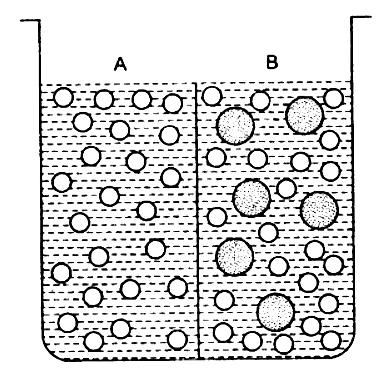
(i) What can you say about the size of the holes in the membrane, if it is to behave semi- permeably between these two?
(ii) Will the solvent molecules pass through the membrane from left to right, from right to left, in either direction or in both directions?
(iii) In which direction will there be a net movement of solvent molecules?
Answer

(i) The size of the holes in the membrane is large enough to allow only the solvent particles to pass through it. But solute particle cannot pass through it. Thus, the membrane acts as the semi-permeable.
(ii) Solvent molecules will pass through the membrane in both directions. Since solvent molecules are present on both the sides they will strike the semi-permeable membrane and pass through the same.
(iii) There is a net movement of solvent molecules from the place of its higher chemical potential to the place of its lower chemical potential, i.e., from right to left.

Need a full question paper?

Generate a complete, print-ready paper with questions like this in minutes — across 16+ boards, with answer keys.

Start Generating Free

Similar questions

Given below is a diagram representing a stage during mitotic cell division. Study it carefully and answer the question that follow.

How will you differentiate between mitosis and meiosis on the basis of the chromosome number in the daughter cells?
Complete the following table by filling in the blank spaces numbered 1 to 8:
GlandSecretionsEffect on body
(1) ………..oestrogen(2) ………..
Alpha cells of islets of Langerhans(3) ……….. (4) ………..
(5) ………..(6) ………..Protruding eyes
(7) ………..(8) ………..Gigantism
Define the four stages in the uterine cycle.
All life owes its existence to chlorophyll. Give reason.
In the given diagram name the parts labeled 1, 2, 3,4 and 5 and describe about them in short.
Classify the types of chromosomes according to their shape.
Label the diagram given below :
A healthy croton plant bearing variegated leaves was kept in a dark cupboard to destarch it after which it was placed in sunlight for a few hours. One of the leaves was then plucked and an outline of the leaf marking the green and the non-green regions was drawn. The leaf was then tested for starch. Using the above information, answer the following questions:
  1. State the aim of the above experiment.
  2. Name the chemical used for testing the presence of starch.
  3. Why is the leaf boiled in water and alcohol before testing for the presence of starch?
  4. What change is seen on the leaf after the starch test?
  5. Give the chemical equation to represent the process of starch formation in plants.
The figures given below show diagrammatic cross-sections of three kinds of blood vessels.

(a) Identify the blood vessels A, B and C
(b) Name the parts labelled 1-4
(c) Mention two structural differences between A and B.
(d) Name the kinds of blood that flow through A and through B respectively.
(e) In which one of the above vessels referred to in (a) above does the exchange of gases actually take place?
Match the terms in Column I with those in Column II and write down the matching pairs
Column I Column II
aBowman's Capsule Renal artery
bContains more CO2 and less urea Regulates amount of water excreted
cAnti-diuretic hormone Renal Vein
dContains more urea Glomerulus