Questions

[3 marks Question Answer]

🎯

Test yourself on this topic

17 questions · timed · auto-graded

Question 13 Marks
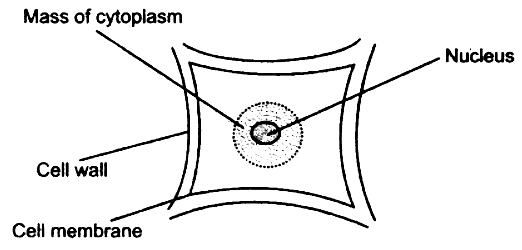
Give a diagrammatic representation of plasmolysis in a cell.
Answer
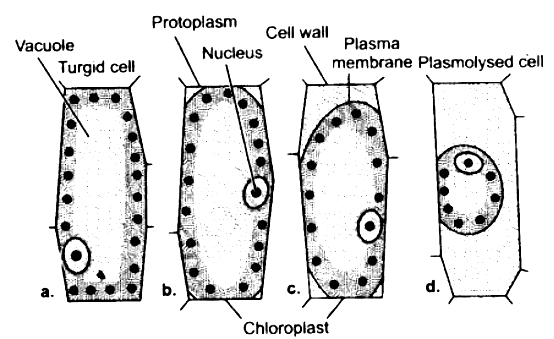
(a) A cell in normal turgid condition
(b) - (d) Successive stages in shrinkage of protoplasm from the cell well after being placed in a hypertonic solution. Diagrammatic representation of plasmolysis in a cell
View full question & answer
Question 23 Marks
Give at least three uses of water to green plants
Answer
(i) Water is major component of protoplasm.
(ii) It is an important raw material for photosynthesis.
(iii) Most metabolic and enzymatic reactions take place in the presence of water.
View full question & answer
Question 33 Marks
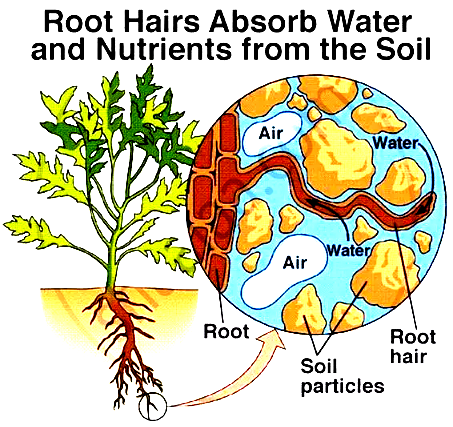
How is root hair structurally adapted for absorption of water from the soil?
Answer
(i) The root hair represents a large surface area in contact with the soil particle.
(ii) The minute root hair can penetrate between the soil particles and when it comes in contact with soil water, the cell membrane allows efficient entry of water into the root.
(iii) The cytoplasm and the vacuoles also help in this water absorption by osmosis.
View full question & answer
Question 43 Marks
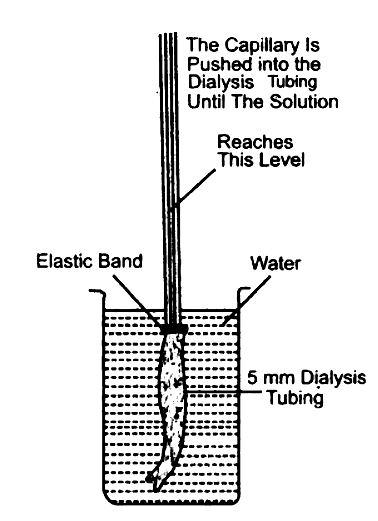
The apparatus arranged here signifies an important process.

(i) Name the process.
(ii) Where does this process occur in plants?
(iii) What solution is placed inside the dialysis tubing?
(iv) What happens to the level of the solution in the capillary tube?
(v) Define the process mentioned in Q. (i) above.
Answer
(1) The process is called osmosis.
(ii) This process occurs in the root hair cells of plants.
(iii) The solution placed inside the dialysis tubing is generally strong sugar solution or salt solution.
(iv) The level of the solution in the capillary tube rises above the original level.
(v) Osmosis is a physiological process where the water molecules or solvent molecules move through a semi-permeable membrane from a solution having a higher concentration of solvent molecules to the solution having a lower concentration of water or solvent molecules.
View full question & answer
Question 53 Marks
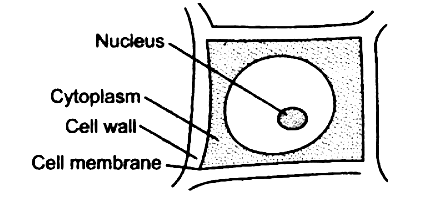
A plant cell kept in a drop of water was examined under the low power magnification of a microscope, as shown:

(i) What would you do to bring this cell back to its original condition?
(ii) What scientific term is used for such condition?
(iii) Draw the same cell if it is kept in a strong sugar solution.
Answer
(i) Put the cell back into the drop of water for sometime. Deplasmolysis occurs.
(ii) Plasmolysis.
(iii) Plasmolysed cell.
View full question & answer
Question 63 Marks
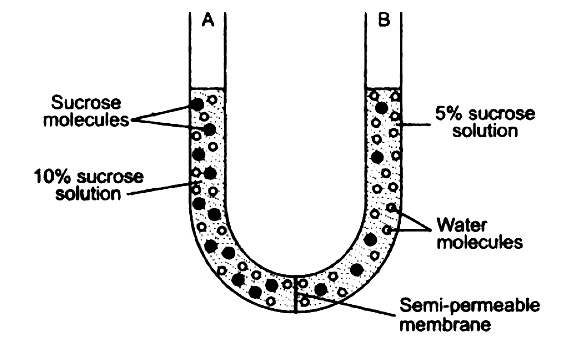
The diagram given below is of an experiment just at the start. Study the diagram carefully and answer the following questions :

(i) What does the experiment demonstrate?
(ii) Define, the process demonstrated in the experiment.
(iii) What changes are observed after a few hours?
(iv) Give two examples of a semi-permeable membrane.
(v) Which limb of the U-tube contains a more concentrated sucrose solution, A or B?
(vi) Why is the membrane separating the two solutions labeled as semi-permeable membrane?
Answer
(i) The process of osmosis.
(ii) Osmosis is a special type of diffusion of solvent molecules through a semi-permeable membrane from a region of their higher concentration to the lower concentration region, but not vice versa.
(iii) The level of water in column A will rise along with the passage of time and will ultimately stop when the concentration of water molecules are equal on both sides of the membrane.
(iv) (a) Parchment paper, (b) Egg membrane.
(v) Solution A.
(vi) It permits the movement of only water molecules to pass through it.
View full question & answer
Question 73 Marks
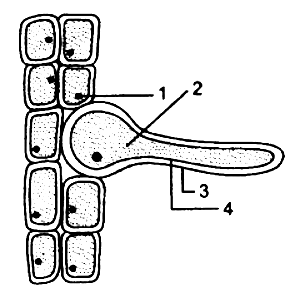
The below figure shows a root hair:

(i) Label the parts 1 to 4.
(ii) What is the role of part 4?
(iii) Why is the root hair one-celled?
(iv) What will happen to the root hair if some fertilizer is added to the soil near the root hair?
Answer
(i) 1. Nucleus
2. Vacuole
3. Cell wall
4. Cell membrane
(ii) Part 4 is the cell membrane. It is semi-permeable. It allows only water molecules to pass through it.
(iii) Because it is an extension of epiblema cell.
(iv) By the addition of fertilizer, root hair becomes flaccid, because water will move out of it as soil water becomes hypertonic.
View full question & answer
Question 83 Marks
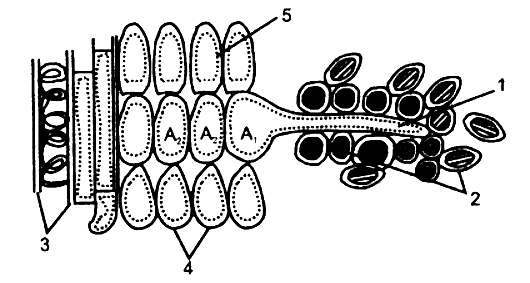
The figure given below is a diagrammatic representation of a part of the cross-section of the root in the root hair zone. Study the same and then answer the questions that follow :

(i) Name the parts indicated by guidelines ‘1’ to ‘5’
(ii) Is the root hair cell unicellular or multi-cellular?
(iii) Draw a labeled diagram of the root hair cell as it would appear if some fertilizer is added to the soil close to it.
(iv) Name the process responsible for the entry of water molecules from the soil into A1 and then A2.
(v) What pressure is responsible for the movement of water in the direction indicated by arrows?
(vi) How is this pressure set up?
Answer
(i) 1. Vacuole (containing cell sap)
2. Soil particles
3. Xylem vessel
4. Cortex cells
5. Vacuole in cortical cells
(ii) Root hair cell is unicellular
(iii) See diagram alongside.
(iv) Osmosis
(v) Osmotic pressure
(vi) This pressure is set up due to the difference in osmotic gradient.
View full question & answer
Question 93 Marks
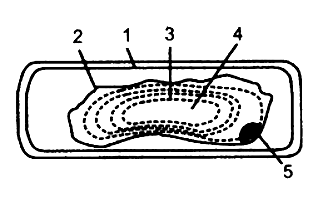
The below diagram represents a plant cell after being placed in a strong sugar solution. Guidelines 1 to 5 indicate the following:

1. Cell wall
2. Plasma membrane.
3. Protoplasm
4. Large vacuole
5. Nucleus
Study the diagram and answer the questions that follow :
(i) What is the state of the cell shown in the diagram?
(ii) Name the structure which acts as a selectively permeable membrane.
(iii) If the cell had been placed in distilled water instead of a strong sugar solution which features: would not have been present?
(iv) If the cell in the diagram possessed chloroplasts where would these be present?
(v) Name any one feature of this plant cell which is not present in animal cells.
Answer
(i) Flaccid.
(ii) Plasma membrane.
(iii) If the cell had been placed in distilled water it remains in a fully distended condition. Its plasma membrane remains in close contact with the cell wall and presses against it.
(iv) Chloroplast will be present in the protoplasm outside the vacuole.
(v) Cell wall.
View full question & answer
Question 103 Marks
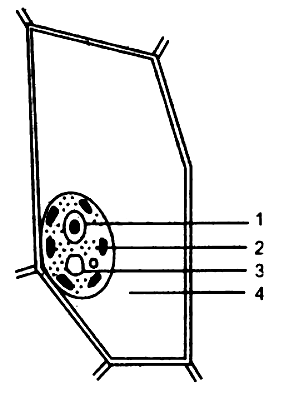
Given below is the diagram of a cell as seen under the microscope after having been placed in a solution:

(i) What is the technical term used for the state/condition of the cell given above?
(ii) Give the technical term for the solution in which the cell was placed.
(iii) Name the parts numbered 1 to 4.
(iv) Is the cell given above a plant cell or an animal cell ? Give two reasons in support of your answer as evident from the diagram.
(v) What would you do to bring this cell back to its original condition?
Answer
(i) Plasmolysis
(ii) Hypertonic solution
(iii) (1) Nucleus, (2) Sugar drops, (3) Small vacuole, (4) Large vacuole.
(iv) Plant cell (1) Presence of cell wall, (2) Presence of large vacuole.
(v) It has to be placed in a hypotonic solution.
View full question & answer
Question 113 Marks
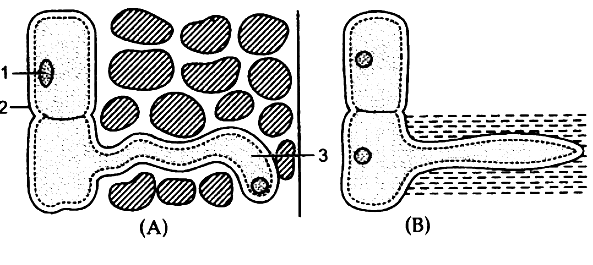
The alongside diagram A shows a root hair growing through the soil particles. Diagram B is the root hair of an aquatic plant.

(i) Name the parts 1,2,3.
(ii) Name two substances which enter the root hair. What are their uses?
(iii) By what process do these substances enter the root hair?
(iv) Account for the different shapes of root hairs in the two diagrams.
Answer
(i) 1-Nucleus. 2-Cell wall. 3-Cytoplasm of the root hair cell.
(ii) 1. Water: Carries minerals to the plant.
2. Minerals: They are needed for healthy plant growth.
(iii) Osmosis.
(iv) In the Fig. A, the root hair has to pass through the soil particles, and as such, they are not straight. In the Fig. B, the root hair has no obstruction in water, and as such it grows straight.
View full question & answer
Question 123 Marks
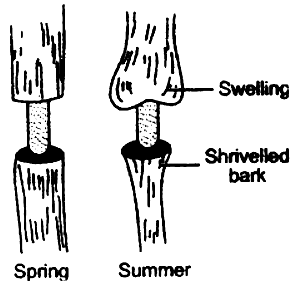
A complete ring of bark was removed from a tree in spring. The tree continued to live through summer but a swelling appeared on the bark above the ring while the bark below shriveled up. Answer the questions given below :

(i) Account for the swelling in the bark above the ring.
(ii) Account for the shrinking of the bark below the ring.
(iii) Name the tissue that distributes food in plants.
(iv) Name the tissue that distributes water in plants.
(v) What is the role of a bark in a plant?
Answer
(i) The phloem has been removed in the part of the ring. The food prepared by leaves comes down through phloem, but since the phloem is cut off, the food gets collected in the upper part of the ring and hence the swelling appears.
(ii) The food prepared by leaves is not able to pass on downward as the phloem has been removed, resulted in the shrinking of the bark.
(iii) Phloem.
(iv) Xylem.
(v) Bark protects the attack of fungi and insects, against loss of water by evaporation and against variation of external temperature and loss of water due to evaporation.
View full question & answer
Question 133 Marks
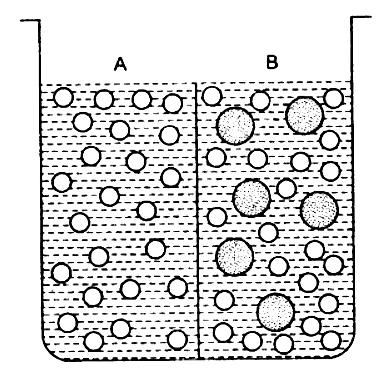
The beaker is divided into two chambers A and B. The big circle represents solute and the small circles solvent.

(i) What can you say about the size of the holes in the membrane, if it is to behave semi- permeably between these two?
(ii) Will the solvent molecules pass through the membrane from left to right, from right to left, in either direction or in both directions?
(iii) In which direction will there be a net movement of solvent molecules?
Answer
(i) The size of the holes in the membrane is large enough to allow only the solvent particles to pass through it. But solute particle cannot pass through it. Thus, the membrane acts as the semi-permeable.
(ii) Solvent molecules will pass through the membrane in both directions. Since solvent molecules are present on both the sides they will strike the semi-permeable membrane and pass through the same.
(iii) There is a net movement of solvent molecules from the place of its higher chemical potential to the place of its lower chemical potential, i.e., from right to left.
View full question & answer
Question 143 Marks
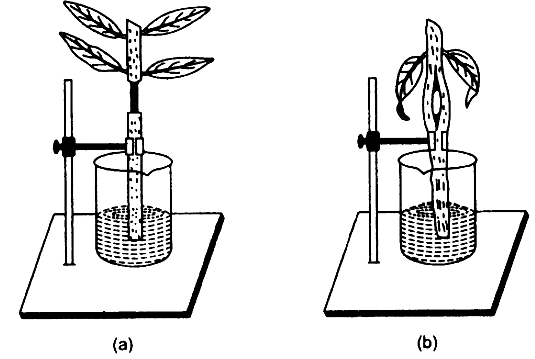
The diagram given below represents the result of an experiment conducted on two freshly taken shoots of a green herbaceous plant. The lower ends dip in the water.

(i) What is the aim of the experiment?
(ii) Some parts of the stem in both the shoots have been removed. Name the conducting tissue in shoot A and in shoot B, that has been removed.
(iii) What are the results of this experiment?
Answer
(i) To demonstrate the role of xylem and phloem in flowering plants.
(ii) In the shoot, A phloem tissue has been removed. In shoot B central xylem tissue has been removed.
(iii) Plant A gets water and minerals and synthesizes its food and remains healthy. Plant B due to lack of xylem does not get its supply of water and minerals. The leaves are seen drooping and will dry.
View full question & answer
Question 153 Marks
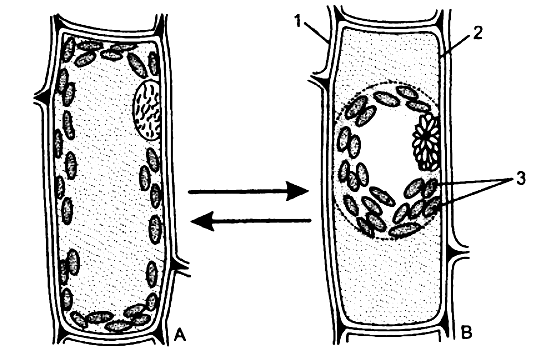
In the figure below ‘A’ shows a cell in the normal state and ‘B’ shows the same cell after leaving it in a certain solution for a few minutes.


(i) Describe the change which has occurred in the cell as seen in B.
(ii) Give the technical term for the condition of the cell as reached in B and as it was in A.
(iii) Define the process which led to this condition.
(iv) What was the solution-isotonic, hypotonic or hypertonic, in which the cell was kept?
(v) How can the cell in B, be brought back to its original condition?
(vi) Name the parts numbered 1 to 3.
Answer
(i) Exosmosis (exit of water) has resulted in the shrinkage of the protoplasm of cell B.
(ii) Plasmolysis and deplasmolysis.
(iii) When plant cells are kept in a hypertonic solution, exosmosis takes place. This process is called plasmolysis.
(iv) Hypertonic solution.
(v) The cell in B can be brought back to its original condition by placing it in a drop of distilled water.
(vi) 1. Cell wall, 2. Plasma membrane, 3. Chloroplast.
View full question & answer
Question 163 Marks
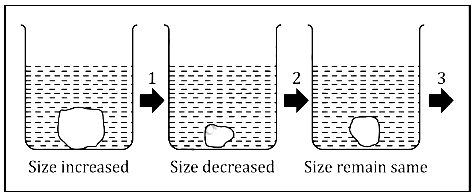
A candidate in order to study the process of osmosis has taken 3 potato cubes and put them in 3 different beakers containing 3 different solutions. After 24 hours, in the first beaker the potato cube increased in size, in the second beaker the potato cube decreased in size and in the third beaker there was no change in the size of the potato cube. The following diagram shows the result of the same experiment:

(i) Give the technical terms of the solutions used in beakers, 1, 2 and 3.
(ii) In beaker 3, the size of the potato cube remains the same. Explain the reason in brief.
(iii) Write the specific feature of the cell sap of root hairs which helps in absorption of water.
(iv) What is osmosis?
(v) How does a cell wall and a cell membrane differ in their permeability?
Answer
(i)
Solution 1 – Hypotonic solution
Solution 2 – Hypertonic solution
Solution 3 – Isotonic solution
(ii) In beaker three, the solution present is an isotonic solution, i.e. the relative concentration of water molecules and solutes is same in the solution as well as inside the cell. There is no movement of water molecules across the cell membrane. Hence, the size of the potato cubes remains same.
(iii) The cell sap of root hairs has higher concentration of solute than the surrounding water.
(iv) Osmosis is the diffusion of water molecules across the semi-permeable membrane from the region of dilute solution (i.e. a lower solute concentration) to the region of concentrated solution (i.e. a higher solute concentration).
(v) The cell wall is freely permeable to all the substances, while the cell membrane is selectively permeable and allows only certain substances to enter or exit the cell.
View full question & answer
Question 173 Marks
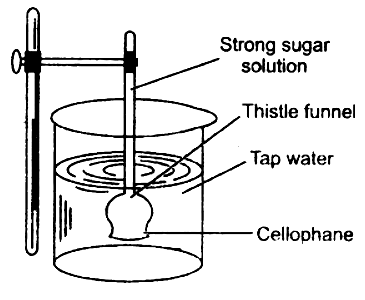
The diagram below represents an experimental set up to demonstrate a vital process. Study the same and then answer the questions that follow:


(i) Name the process.
(ii) Define the above named process.
(iii) What would you observe in the experimental setup after an hour or so?
(iv) What control experiment can be set up for the above experiment?
(v) Keeping in mind the root hair cell and its surrounding name the part that corresponds to (1) Concentrated sugar solution, (2) Parchment paper, (3) Water in the beaker.
(vi) Name any other substance that can be used instead of parchment paper in the above experiment.
(vii) Mention two advantages of this process to the plant.
Answer
(i) Osmosis.
(ii) Transfer of water or solvent molecules from a solution of lower concentration to a solution of higher concentration through a semi-permeable membrane is called osmosis.
(iii) The level of sugar solution rises in the stem of thistle funnel, whereas the water level in the beaker falls.
(iv) A non-permeable membrane can be used in place of parchment paper for a control experiment.
(v) (1) Root hair cell sap corresponds to concentrated sugar solution.
(2) Cell membrane of root hair cell corresponds to parchment paper.
(3) Soil solution corresponds to water in the beaker.
(vi) Goat’s bladder or pig’s bladder.
(vii) (1) Helps in water absorption.
(2) Helps in stomatal opening and closing thus facilitating gaseous exchange.
View full question & answer
[3 marks Question Answer] - Biology STD 10 Questions - Vidyadip