MCQ
The Bernauli's Theorem is based on the conservation of:
  • A
    Mass.
  • B
    Energy.
  • C
    Momentum.
  • D
    All.

Answer

  1. Energy.

Need a full question paper?

Generate a complete, print-ready paper with questions like this in minutes — across 16+ boards, with answer keys.
Start Generating Free

Similar questions

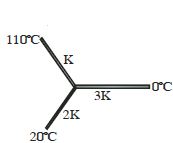
Three rods of equal length and cross sectional area and coefficient of thermal conductivities $K, 2K$ and $3K$ are joined as shown in figure temperature of their ends are $110\ ^oC, 20\ ^oC$ and $0\ ^oC$ respectively then temperature of junction will be ......... $^oC$
At the top of the trajectory of a projectile, the acceleration is
A smooth sphere $A$ is moving on a frictionless horizontal plane with angular speed $\omega $ and center of mass with velocity $v$. It collides elastically and head-on with an identical sphere $B$ at rest. Neglect friction everywhere. After the collision, their angular speeds are ${\omega _A}$ and ${\omega _B}$ respectively. Then
The escape velocity for the earth is $11.2\, km/sec$. The mass of another planet is $100$ times that of the earth and its radius is $4$ times that of the earth. The escape velocity for this planet will be ......... $km/sec$​
If $a, b, c$ are the percentage errors in the measurement of $A, B$ and $C$, then the percentage error in $ABC$ would be approximately
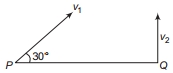
A projectile $A$ is thrown at an angle $30^{\circ}$ to the horizontal from point $P$. At the same time another projectile $B$ is thrown with velocity $v_2$ upwards from the point $Q$ vertically below the highest point $A$ would reach. For $B$ to collide with $A$, the ratio $\frac{v_2}{v_1}$ should be
Which of the following is not a thermodynamics co-ordinate
A copper wire of length $4.0m$ and area of cross-section $1.2\,c{m^2}$ is stretched with a force of $4.8 \times {10^3}$ $N.$ If Young’s modulus for copper is $1.2 \times {10^{11}}\,N/{m^2},$ the increase in the length of the wire will be
A balloon contains $500\,{m^3}$ of helium at $27°C$ and $1$ atmosphere pressure. The volume of the helium at $-3°C$ temperature and $0.5$ atmosphere pressure will be ..... $m^3$
$\overrightarrow A = 2\hat i + \hat j,\,B = 3\hat j - \hat k$ and $\overrightarrow C = 6\hat i - 2\hat k$.Value of $\overrightarrow A - 2\overrightarrow B + 3\overrightarrow C $ would be