The blocks are given velocity in the direction shown in figure. Co-efficient of friction between two blocks shown in figure is $μ = 0.5$. Take $g = 10\ m/s^2$
(considering $4\ kg$ block doesn't fall on ground)
Consider the following statements
$(i)$ Time when relative motion between them is stopped is $1.4\ second$.
$(ii)$ Time when relative motion between them is stopped in $1.2\ second$
$(iii)$ The common velocity of the two blocks is $8\ m/s$, towards right.
$(iv)$ The displacement of the $4\, kg$ block when relative motion stopped is$10.8\ m$.
Which of the fstatements is/are correct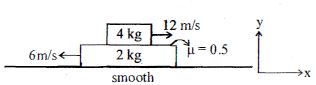
Advanced
Download our app for free and get started
$a_{2}=-\frac{20}{4}=-5 \mathrm{m} / \mathrm{s}^{2}$
$a_{1}=\frac{20}{2}=+10 \mathrm{m} / \mathrm{s}^{2}$
Relative motion stopped when
$\mathrm{v}_{1}=\mathrm{v}_{2}$ $-6+10 t=12-5 t$
$t=\frac{18}{15}=1.2 \sec$
common velocity $=-6+10 t$
$=-6+10 \times 1.2=6 \mathrm{m} / \mathrm{s}$
Displacement of $4 \mathrm{kg}$ block
$=\frac{12 \times 6}{5}-\frac{1}{2} \times 5 \times\left(\frac{6}{5}\right)^{2}=\frac{72}{5}-\frac{36}{10}=10.8 \mathrm{m}$

Download our appand get started for free
Experience the future of education. Simply download our apps or reach out to us for more information. Let's shape the future of learning together!No signup needed.*
Similar Questions
- 1A block of mass $2 kg$ slides down an incline plane of inclination $30^o$. The coefficient of friction between block and plane is $0.5$. The contact force between block and plank is :View Solution
- 2A body of mass $5\, kg$ is moving in a circle of radius $1\,m$ with an angular velocity of $2$ radian/sec. The centripetal force is ......... $N$View Solution
- 3At time $t=0$, a disk of radius $1 m$ starts to roll without slipping on a horizontal plane with an angular acceleration of $\alpha=\frac{2}{3} rad s ^{-2}$. A small stone is stuck to the disk. At $t=0$, it is at the contact point of the disk and the plane. Later, at time $t=\sqrt{\pi} s$, the stone detaches itself and flies off tangentially from the disk. The maximum height (in $m$ ) reached by the stone measured from the plane is $\frac{1}{2}+\frac{x}{10}$. The value of $x$ is. . . . . . .[Take $g=10 m s ^{-2}$.]View Solution
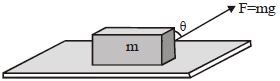
- 4A force $f$ is acting on a block of mass $m$. Coefficient of friction between block and surface is $\mu$. The block can be pulled along the surface if :-View Solution
- 5A body is moving along a rough horizontal surface with an initial velocity $6\,\,m/s.$ If the body comes to rest after travelling $9\, m$, then the coefficient of sliding friction will beView Solution
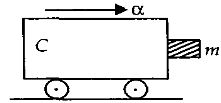
- 6A block of mass $m$ is in contact with the cart $C$ as shown in the figure. The coefficient of static friction between the block and the cart is $\mu .$ The acceleration $\alpha$ of the cart that will prevent the block from falling satisfiesView Solution
- 7A car of mass $1000\,kg$ negotiates a banked curve of radius $90\,m$ on a frictionless road. If banking angle is $45^o$ , the maximum speed of car is ............ $m/s$ $[g = 10\,m/s^2]$View Solution
- 8A block of wood resting on an inclined plane of angle $30^o$, just starts moving down. If the coefficient of friction is $0.2$, its velocity (in $ms^{-1}$) after $5\, seconds$ is : $(g = 10\, ms^{-2})$View Solution
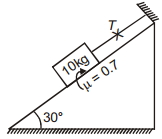
- 9The tension $T$ in the string shown in figure is ..................... $N$View Solution
- 10A uniform chain of length $L$ which hanges partially from a table, is kept in equilibrium by friction. The maximum length that can withstand without slipping is $l$ , then coefficient of friction between the table and the chain isView Solution