A body of mass $5\, kg$ is moving in a circle of radius $1\,m$ with an angular velocity of $2$ radian/sec. The centripetal force is ......... $N$
AIIMS 1998, Easy
Download our app for free and get started
(b)Centripetal force$ = mr{\omega ^2} = 5 \times 1 \times {(2)^2} = 20\,N$

Download our appand get started for free
Experience the future of education. Simply download our apps or reach out to us for more information. Let's shape the future of learning together!No signup needed.*
Similar Questions
- 1Below are two statements. One is labeled as Assertion $(A)$ and the other as Reason $(R).$View Solution
Assertion $(A):$ The property of an object that allows it to regain its original shape after the external force applied to it is removed is called elasticity.
Reason $(R):$ The restoring force depends on the intermolecular and interatomic forces in a solid.
In the context of the above statements, choose the most appropriate answer from the options given below:
- 2A block of mass $5 kg$ is at rest on a rough inclined surface. If angle of inclination of plane is $60^{\circ}$, then force applied by it on block is .......... $N$View Solution
- 3View SolutionA car when passes through a convex bridge exerts a force on it which is equal to
- 4A marble block of mass $2\, kg$ lying on ice when given a velocity of $6 \,m/s$ is stopped by friction in $10\,s$. Then the coefficient of friction isView Solution
- 5$A$ particle inside the rough surface of $a$ rotating cone about its axis is at rest relative to it at $a$ height of $1m$ above its vertex. Friction coefficient is $\mu = 0.5$, if half angle of cone is $45^o$, the maximum angular velocity of revolution of cone can be :View Solution
- 6A small mass $'m'$ rests at the edge of a horizontal disc of radius $'R'$ . The coefficient of static friction between mass and the disc is $\mu $ . The disc is rotated about its axis at an angular velocity such that the mass slides off the disc and lands on the floor $'h'$ meters below. What was its horizontal distance of travel from the point it left the disc?View Solution
- 7The upper portion of an inclined plane of inclination $\alpha $ is smooth and the lower portion is rough. A particle slides down from rest from the top and just comes to rest at the foot. If the ratio of the smooth length to rough length is $m : n$ , the coefficient of friction isView Solution
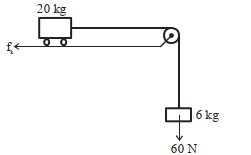
- 8Consider a block and trolley system as shown in figure. If the coefficient of kinetic friction between the trolley and the surface is $0.04$ , the acceleration of the system in $\mathrm{ms}^{-2}$ is :View Solution
(Consider that the string is massless and unstretchable and the pulley is also massless and frictionless):
- 9An isolated rail car originally moving with speed $v_0$ on a straight, frictionles, level track contains a large amount of sand. $A$ release valve on the bottom of the car malfunctions, and sand begins to pour out straight down relative to the rail car. What happens to the speed of the rail car as the sand pours out?View Solution
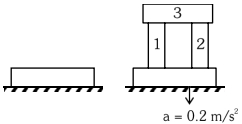
- 10A steel block of $10\, {kg}$ rests on a horizontal floor as shown. When three iron cylinders are placed on it as shown, the block and cylinders go down with an acceleration $0.2\, {m} / {s}^{2}$. The normal reaction ${R}$ by the floor if mass of the iron cylinders are equal and of $20\, {kg}$ each, is .....$N.$ [Take ${g}=10\, {m} / {s}^{2}$ and $\mu_{{s}}=0.2$ ]View Solution