Question
The bond, that exists in a semiconductor is:

Answer

  1. Covalent bond
Explanation:
Semi-conductors are made of 14th Group elements which form covalent bonding.

Need a full question paper?

Generate a complete, print-ready paper with questions like this in minutes — across 16+ boards, with answer keys.
Start Generating Free

Similar questions

A radioactive sample is $a-$emitter with half life $138.6$ days is observed by a student to have $2000$ disintegration$/\sec$. The number of radioactive nuclei for given activity are
Two non ideal batteries are connected in series. Consider the following statements
(A) The equivalent emf is larger than either of the two emfs.
(B) The equivalent internal resistance is smaller than either of the two internal resistances.
When light of wavelength 300 nm (nanometer) falls on a photoelectric emitter, photoelectrons are liberated. For another emitter, however light of 600 nm wavelength is sufficient for creating photoemission. What is the ratio of the work functions of the two emitters(a) 1 : 2(b) 2 : 1(c) 4 : 1(d) 1 : 4
       
An electron is moving along the positive x-axis. You want to apply a magnetic field for a short time so that the electron may reverse its direction and move parallel to the negative x-axis. This can be done by applying the magnetic field along:
  1. y-axis.
  2. z-axis.
  3. y-axis only.
  4. z-axis only.
A electron $( q=1.6 \times 10^{-19} \mathrm{C} )$ is moving at right angle to the uniform magnetic field $3.534 \times 10^{-5} \mathrm{~T}.$ The time taken by the electron to complete a circular orbit is
The total charge of the electric dipole is:
Photon of 5.5 eV energy fall on the surface of the metal emitting photoelectrons of maximum kinetic energy 4.0 eV. The stopping voltage required for these electrons are(a) 5.5 V(b) 1.5V (c) 9.5V (d) 4.0V
       
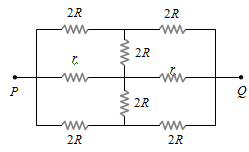
The effective resistance between points $P$ and $Q$ of the electrical circuit shown in the figure is
For moving ball of cricket, the correct statement about de$-$Broglie wavelength is
S.I. unit of power of a lens is :