Question
The breakdown in a reverse biased p-n junction diode is more likely to occur due to.

Answer

  1. Large velocity of the minority charge if the doping concentration is small.
Explanation:
When it comes to he breakdown in a reverse biased PN junction diode, it will probably happen only because of the accumulation of the higher charge at the biased region and large velocity of the minority charge if the doping concentration is small. This is the main cause the breakdown.

Need a full question paper?

Generate a complete, print-ready paper with questions like this in minutes — across 16+ boards, with answer keys.
Start Generating Free

Similar questions

The antenna current of an AM transmitter is 8 A when only carrier is sent but increases to 8.96 A when the carrier is sinusoidally modulated. The percentage modulation is (a) 50%   (b) 60%(c) 65%   (d) 71%
       
Nuclear fusion is common to the pair(a) Thermonuclear reactor, uranium based nuclear reactor(b) Energy production in sun, uranium based nuclear reactor(c) Energy production in sun, hydrogen bomb(d) Disintegration of heavy nuclei, hydrogen bomb


The electric flux through a certain area of dielectric is $8.76 \times 10^3t^4.$ The displacement current through the area is $12.9\ pA$ at $t = 26.1\ ms .$ Find the dielectric constant of the material.
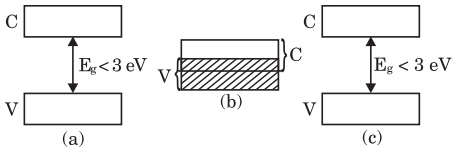
Energy Bands of three substances are shown in the following figures, where V is valance band and C is conduction band.
Image
These substances respectively are :
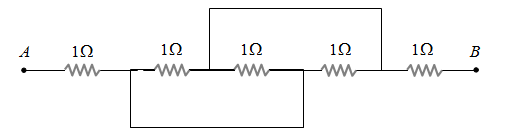
Equivalent resistance between the points $A$ and $B$ is $($in $\Omega)$
An emf is induced in an aeroplane during its ascent and descent in east-west direction due to.
Magnetic lines of force due to a bar magnet do not intersect because:
The chemical equivalent of copper and zinc are 32 and 108 respectively. When copper and silver voltameter are connected in series and electric current is passed through for sometimes, 1.6 g of copper is deposited. Then, the mass of silver deposited will be(a) 3.5 g  (b) 2.8 g(c) 5.4 g  (d) None of these
       
If two lenses of +5 diopters are mounted at some distance apart, the equivalent power will always be negative if the distance is(a) Greater than 40 cm(b) Equal to 40 cm(c) Equal to 10 cm(d) Less than 10 cm
   
   
The amount of heat produced in a resistor when a current is passed through it can be found using (a) Faraday’s Law(b) Kirchhoff’s Law(c) Laplace’s Law(d) Joule’s Law