MCQ
The breaking stress of aluminium is $7.5 \times 10^7 \,Nm ^{-2}$. The greatest length of aluminium wire that can hang vertically without breaking is ......... $\times 10^3 \,m$ (Density of aluminium is $2.7 \times 10^3 \,kg m ^{-3}$ )
  • A
    $283$
  • B
    $28.3$
  • $2.83$
  • D
    $0.283$

Answer

Correct option: C.
$2.83$
c
(c)

Breaking stress $=\rho \times g \times L$

Substitute values from the question

Breaking stress $=7.5 \times 10^7 \,Nm ^{-2}$

$\left\{\begin{array}{l}\rho=\text { Density of material } \\ g=\text { Acceleration due to gravity } \\ L=\text { Length of wire that can hang without breaking }\end{array}\right\}$

$\rho=2.7 \times 10^3 \,kg m ^{-3}$

$g=9.8 \,m / s$

$7.5 \times 10^7=2.7 \times 10^3 \times 9.8 \times L$

Need a full question paper?

Generate a complete, print-ready paper with questions like this in minutes — across 16+ boards, with answer keys.

Start Generating Free

Similar questions

Acceleration of a particle which is at rest at $x = 0 $ is $\vec{\text{a}}=(4-2\text{x})\hat{\text{i}}.$ Select the correct alternative(s):
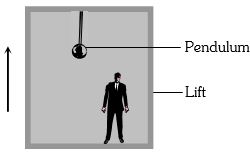
A man measures the period of a simple pendulum inside a stationary lift and finds it to be $T$ sec. If the lift accelerates upwards with an acceleration $\frac{g}{4}$, then the period of the pendulum will be
Which of the following is not a unit of energy
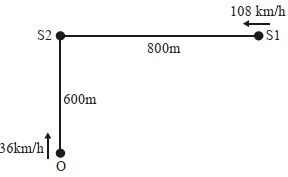
A train $S1$, moving with a uniform velocity of $108 km / h$, approaches another train $S 2$ standing on a platform. An observer $O$ moves with a uniform velocity of $36 km / h$ towards $S 2$, as shown in figure. Both the trains are blowing whistles of same frequency $120 Hz$. When $O$ is $600 m$ away from $S 2$ and distance between $S 1$ and $S 2$ is $800 m$, the number of beats heard by $O$ is. . . . . [Speed of the sound $=330 m / s$ ]
A rectangular block is $5 cm × 5 cm × 10cm$  in size. The block is floating in water with $ 5 cm $ side vertical. If it floats with $10 cm $ side vertical, what change will occur in the level of water?
A person in a lift is holding a water jar, which has a small hole at the lower end of its side. When the lift is at rest, the water jet coming out of the hole hits the floor of the lift at a distance $d$ of $1.2 \ m$ from the person. In the following, state of the lift's motion is given in List - $I$ and the distance where the water jet hits the floor of the lift is given in List - $II$. Match the statements from List - $I$ with those in List- $II$ and select the correct answer using the code given below the lists.
 List - $I$  List - $II$
$P.\quad$ Lift is accelerating vertically up. $1.\quad$ $d=1.2 \ m$
$Q.\quad$ Lift is accelerating vertically down with an accelerating less than the gravitational acceleration. $2.\quad$ $d>1.2 \ m$
$R.\quad$ List is moving vertically up with constant Speed $3.\quad$ $d<1.2 \ m$
$S.\quad$ Lift is falling freely. $4.\quad$ No water leaks out of the jar
Water flows into a cylindrical vessel of large cross-sectional area at a rate of $10^{-4}$ $m^3/s$. It flows out from a hole of area $10^{-4}$ $m^2$, which has been punched through the base. How high does the water rise in the vessel?
Consider the equations $\text{P}=\lim_\limits{\triangle\text{s}\rightarrow0}\frac{\text{F}}{\triangle\text{s}}$ and $\text{P}_1-\text{P}_2-\text{pgz}$ In an elevator accelerating upward.
 
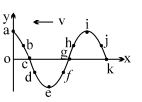
The figure represents the instantaneous picture of a longitudinal harmonic wave travelling along the negative $x$-axis. Identify the correct statement $(s)$ related to the movement of the points shown in the figure. The stationary points are
A man drops a ball downside from the roof of a tower of height $400 m\,eters$. At the same time another ball is thrown upside with a velocity $50\, meter/sec$. from the surface of the tower, then they will meet at which height from the surface of the tower............$meters$