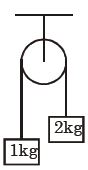
The breaking stress of wire going over a smooth pully is $2 \times 10^9\, N/m^2$. What would be the minimum radius of wire used if it is not to break?
Diffcult
Download our app for free and get started
$20-T=2 a$ $...(1)$
$\mathrm{T}-10=1 \mathrm{a}$ $...(2)$
$\Rightarrow \mathrm{T}=\frac{40}{3} \mathrm{N}$
Stress $=\frac{\mathrm{T}}{\mathrm{A}} \Rightarrow 2 \times 10^{9}=\frac{40 / 3}{\mathrm{A}}$
$A=\frac{20}{3} \times 10^{-9} \mathrm{m}^{2}$
$\pi r^{2}=\frac{20}{3} \times 10^{-9}$
$r=\left(\frac{20}{3} \times \frac{10^{-9}}{3.14}\right)^{1 / 2}=0.46 \times 10^{-4} \mathrm{m}$

Download our appand get started for free
Experience the future of education. Simply download our apps or reach out to us for more information. Let's shape the future of learning together!No signup needed.*
Similar Questions
- 1Join details of Column$-II$ with given information in Column$-I$ appropriatelyView Solution
Column $-I$ Column $-II$ $(a)$ Stress is proportional to strain.
$(i)$ Elastic limit $(b)$ When the load of the wire is removed, the body does regain its original dimension. $(ii)$ Limit of pro-portionality $(iii)$ Plastic deformation - 2A wire can be broken by applying a load of $20\, kg$ weight. The force required to break the wire of twice the diameter is .......... $kg\, wt$View Solution
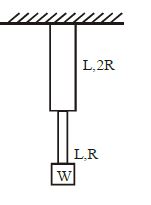
- 3Two wires of the same material (Young's modulus $Y$ ) and same length $L$ but radii $R$ and $2R$ respectively are joined end to end and a weight $W$ is suspended from the combination as shown in the figure. The elastic potential energy in the system isView Solution
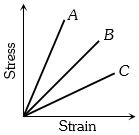
- 4The stress-strain curves for brass, steel and rubber are shown in the figure. The lines $A, B$ and $C$ are forView Solution
- 5The ratio of radii of two wires of same material is $2: 1$. If these wires are stretched by equal force, the ratio of stresses produced in them is $.............$View Solution
- 6Join details of Column$-II$ with given information in Column$-I$ appropriatelyView Solution
Column $-I$ Column $-II$ $(a)$ Stress is proportional to strain.
$(i)$ Elastic limit $(b)$ When the load of the wire is removed, the body does regain its original dimension. $(ii)$ Limit of pro-portionality $(iii)$ Plastic deformation - 7A wire of length $2\, m$ is made from $10\;c{m^3}$ of copper. A force $F$ is applied so that its length increases by $2\, mm.$ Another wire of length 8 m is made from the same volume of copper. If the force $F$ is applied to it, its length will increase by......... $cm$View Solution
- 8An area of cross-section of rubber string is $2\,c{m^2}$. Its length is doubled when stretched with a linear force of $2 \times {10^5}$dynes. The Young's modulus of the rubber in $dyne/c{m^2}$ will beView Solution
- 9Two steel wires of same length but radii $r$ and $2r$ are connected together end to end and tied to a wall as shown. The force stretches the combination by $10\ mm$. How far does the midpoint $A$ move ............ $mm$View Solution

- 10A rubber cord catapult has cross-sectional area $25\,m{m^2}$ and initial length of rubber cord is $10\,cm.$ It is stretched to $5\,cm.$ and then released to project a missile of mass $5gm.$ Taking ${Y_{rubber}} = 5 \times {10^8}N/{m^2}$ velocity of projected missile is ......... $ms^{-1}$View Solution