The ratio of radii of two wires of same material is $2: 1$. If these wires are stretched by equal force, the ratio of stresses produced in them is $.............$
Easy
Download our app for free and get started
We know,
$\text { Stress }=\frac{\text { Force }}{\text { Area }}$
So, Stress $\times$ Area $=$ Force
$S \times A=F$
$\left\{\begin{array}{l}S=\text { Stress } \\ F=\text { Force } \\ A=\text { Area } \\ r=\text { radius }\end{array}\right\}$
$\because \ ($Since$)$ Force applied on the wires is equal we can relate two conditions as
$S_1 A_1=S_2 A_2$
$\frac{S_1}{S_2}=\frac{A_2}{A_1}=\frac{\pi r_2^2}{\pi r_1^2}$
$\frac{S_1}{S_2}=\frac{r^2}{(2 r)^2}=\frac{r^2}{4 r^2}=\frac{1}{4}$
$\left\{\begin{array}{l}\text { Where } \\ S_1-\text { Stress in } 1^{\text {st }} \text { wire } \\ A_1-\text { Area of } 1^{\text {st }} \text { wire } \\ r_1-\text { Radius of } 1^{\text {st }} \text { wire } \\ S_2-\text { Stress in } 2^{\text {nd }} \text { wire } \\ A_2-\text { Area of } 2^{\text {nd }} \text { wire } \\ r_2-\text { Radius of } 2^{\text {nd }} \text { wire }\end{array}\right\}$
$\text { Stress }=\frac{\text { Force }}{\text { Area }}$
So, Stress $\times$ Area $=$ Force
$S \times A=F$
$\left\{\begin{array}{l}S=\text { Stress } \\ F=\text { Force } \\ A=\text { Area } \\ r=\text { radius }\end{array}\right\}$
$\because \ ($Since$)$ Force applied on the wires is equal we can relate two conditions as
$S_1 A_1=S_2 A_2$
$\frac{S_1}{S_2}=\frac{A_2}{A_1}=\frac{\pi r_2^2}{\pi r_1^2}$
$\frac{S_1}{S_2}=\frac{r^2}{(2 r)^2}=\frac{r^2}{4 r^2}=\frac{1}{4}$
$\left\{\begin{array}{l}\text { Where } \\ S_1-\text { Stress in } 1^{\text {st }} \text { wire } \\ A_1-\text { Area of } 1^{\text {st }} \text { wire } \\ r_1-\text { Radius of } 1^{\text {st }} \text { wire } \\ S_2-\text { Stress in } 2^{\text {nd }} \text { wire } \\ A_2-\text { Area of } 2^{\text {nd }} \text { wire } \\ r_2-\text { Radius of } 2^{\text {nd }} \text { wire }\end{array}\right\}$

Download our appand get started for free
Experience the future of education. Simply download our apps or reach out to us for more information. Let's shape the future of learning together!No signup needed.*
Similar Questions
- 1The bulk modulus of a gas is defined as $B=-V d p / d V$. For an adiabatic process the variation of $B$ is proportional to $p^n$. For an ideal gas $n$ isView Solution
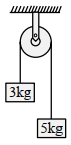
- 2Two blocks of masses $3 \,{kg}$ and $5\, {kg}$ are connected by a metal wire going over a smooth pulley. The breaking stress of the metal is $\frac{24}{\pi} \times 10^{2}\, {Nm}^{-2}$. What is the minimum radius of the wire? (Take $\left.g=10\, {ms}^{-2}\right)$ (in $cm$)View Solution
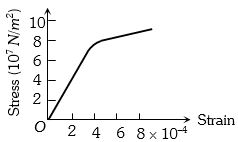
- 3Which one of the following is the Young’s modulus $($in $N/m^2)$ for the wire having the stress-strain curve shown in the figureView Solution
- 4Column$-II$ is related to Column$-I$. Join them appropriately :View Solution
Column $-I$ Column $-II$ $(a)$ When temperature raised Young’s modulus of body $(i)$ Zero $(b)$ Young’s modulus for air $(ii)$ Infinite $(iii)$ Decreases $(iv)$Increases - 5A horizontal steel railroad track has a length of $100 \,m$, when the temperature is $25^{\circ} C$. The track is constrained from expanding or bending. The stress on the track on a hot summer day, when the temperature is $40^{\circ} C$ is ............. $\times 10^7\,Pa$ (Note : The linear coefficient of thermal expansion for steel is $1.1 \times 10^{-5} /{ }^{\circ} C$ and the Young's modulus of steel is $2 \times 10^{11} \,Pa$ )View Solution
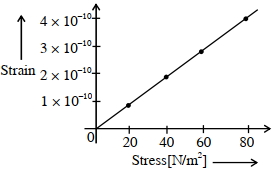
- 6The elastic behaviour of material for linear streass and linear strain, is shown in the figure. The energy density for a linear strain of $5 \times 10^{-4}$ is $\dots \; kJ / m ^{3}$. Assume that material is elastic upto the linear strain of $5 \times 10^{-4}$.View Solution
- 7A copper wire and a steel wire of the same diameter and length are connected end to end and a force is applied, which stretches their combined length by $1\, cm$. The two wires will haveView Solution
- 8The elastic limit of brass is $379\,MPa.$ .......... $mm$ should be the minimum diameter of a brass rod if it is to support a $400\,N$ load without exceeding its elastic limit .View Solution
- 9When a $4\, kg$ mass is hung vertically on a light spring that obeys Hooke's law, the spring stretches by $2\, cms$. The work required to be done by an external agent in stretching this spring by $5\, cms$ will be ......... $joule$ $(g = 9.8\,metres/se{c^2})$View Solution
- 10The diagram shows the change $x$ in the length of a thin uniform wire caused by the application of stress $F$ at two different temperatures $T_1$ and $T_2$. The variations shown suggest thatView Solution