The bulk moduli of ethanol, mercury and water are given as $0.9, 25$ and $2 .2$ respectively in units of $10^9\, Nm^{-2}$ . For a given value of pressure, the fractional compression in volume is $\frac{{\Delta V}}{V}$. Which of the following statements about $\frac{{\Delta V}}{V}$ for these three liquids is correct ?
JEE MAIN 2014, Medium


Download our appand get started for free
Experience the future of education. Simply download our apps or reach out to us for more information. Let's shape the future of learning together!No signup needed.*
Similar Questions
- 1If $Y, K$ and $\eta$ are the values of Young's modulus, bulk modulus and modulus of rigidity of any material respectively. Choose the correct relation for these parameters.View Solution
- 2A rod of length $l$ and radius $r$ is joined to a rod of length $l/2$ and radius $r/2$ of same material. The free end of small rod is fixed to a rigid base and the free end of larger rod is given a twist of $\theta°$, the twist angle at the joint will beView Solution
- 3Two similar wires under the same load yield elongation of $0.1$ $mm$ and $0.05$ $mm$ respectively. If the area of cross- section of the first wire is $4m{m^2},$ then the area of cross section of the second wire is..... $mm^2$View Solution
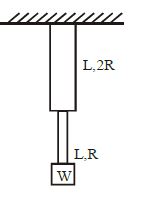
- 4Two wires of the same material (Young's modulus $Y$ ) and same length $L$ but radii $R$ and $2R$ respectively are joined end to end and a weight $W$ is suspended from the combination as shown in the figure. The elastic potential energy in the system isView Solution
- 5A cylindrical wire of radius $1\,\, mm$, length $1 m$, Young’s modulus $= 2 × 10^{11} N/m^2$, poisson’s ratio $\mu = \pi /10$ is stretched by a force of $100 N$. Its radius will becomeView Solution
- 6For silver, Young's modulus is $7.25 \times {10^{10}}\,N/{m^2}$ and Bulk modulus is $11 \times {10^{10}}\,N/{m^2}$. Its Poisson's ratio will beView Solution
- 7An elastic material of Young's modulus $Y$ is subjected to a stress $S$. The elastic energy stored per unit volume of the material isView Solution
- 8The Young's modulus of a steel wire of length $6\,m$ and cross-sectional area $3\,mm ^2$, is $2 \times 11^{11}\,N / m ^2$. The wire is suspended from its support on a given planet. A block of mass $4\,kg$ is attached to the free end of the wire. The acceleration due to gravity on the planet is $\frac{1}{4}$ of its value on the earth. The elongation of wire is (Take $g$ on the earth $=10$ $\left.m / s ^2\right):$View Solution
- 9$Assertion :$ Solids are least compressible and gases are most compressible.View Solution
$Reason :$ solids have definite shape and volume but gases do not have either definite shape or definite volume. - 10View SolutionAccording to Hook’s law force is proportional to