Two similar wires under the same load yield elongation of $0.1$ $mm$ and $0.05$ $mm$ respectively. If the area of cross- section of the first wire is $4m{m^2},$ then the area of cross section of the second wire is..... $mm^2$
Medium


Download our appand get started for free
Experience the future of education. Simply download our apps or reach out to us for more information. Let's shape the future of learning together!No signup needed.*
Similar Questions
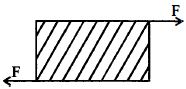
- 1As shown in the figure, forces of $10^5\,N$ each are applied in opposite directions, on the upper and lower faces of a cube of side $10\,cm$, shifting the upper face parallel to itself by $0.5\,cm$ . If the side of another cube of the same material is, $20\,cm$ then under similar conditions as above, the displacement will be......... $cm$View Solution
- 2View SolutionWith rise in temperature, the Young's modulus of elasticity
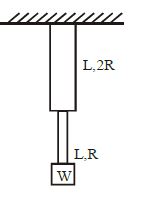
- 3Two wires of the same material (Young's modulus $Y$ ) and same length $L$ but radii $R$ and $2R$ respectively are joined end to end and a weight $W$ is suspended from the combination as shown in the figure. The elastic potential energy in the system isView Solution
- 4View SolutionMark the wrong statement
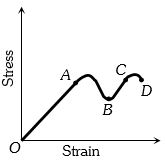
- 5In the below graph, point $D$ indicatesView Solution
- 6A thick rope of density $\rho$ and length $L$ is hung from a rigid support. The Young's modulus of the material of rope is $Y$. The increase in length of the rope due to its own weight isView Solution
- 7The force required to stretch a steel wire of $1\,c{m^2}$ cross-section to $1.1$ times its length would be $(Y = 2 \times {10^{11}}\,N{m^{ - 2}})$View Solution
- 8The Young's modulus of a wire is $Y.$ If the energy per unit volume is $E$, then the strain will beView Solution
- 9A stone of mass $20\, {g}$ is projected from a rubber catapult of length $0.1\, {m}$ and area of cross section $10^{-6} \,{m}^{2}$ stretched by an amount $0.04\, {m}$. The velocity of the projected stone is $....\,m\,/s.$ (Young's modulus of rubber $=0.5 \times 10^{9}\, {N} / {m}^{2}$ )View Solution
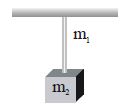
- 10One end of a uniform rod of mass $m_1$ and crosssectional area $A$ is hung from a ceiling. The other end of the bar is supporting mass $m_2$. The stress at the midpoint isView Solution