The bulk modulus of rubber is $9.1 \times 10^8\,N/m^2$. To what depth a rubber ball be taken in a lake so that its volume is decreased by $0.1\%$ ? ....... $m$
Medium


Download our appand get started for free
Experience the future of education. Simply download our apps or reach out to us for more information. Let's shape the future of learning together!No signup needed.*
Similar Questions
- 1An aluminium rod with Young's modulus $Y =7.0$ $\times 10^{10} N / m ^2$ undergoes elastic strain of $0.04 \%$. The energy per unit volume stored in the rod in SI unit is:View Solution
- 2Young's modulus of rubber is ${10^4}\,N/{m^2}$ and area of cross-section is $2\,c{m^2}$. If force of $2 \times {10^5}$ dynes is applied along its length, then its initial length $l$ becomesView Solution
- 3View SolutionThe spring balance does not read properly after its long use, because
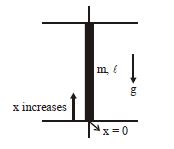
- 4A uniform dense rod with non uniform young's modulus is hanging from ceiling under gravity. If elastic energy density at every point is same then young's modulus with $x$ will change as which of the shown graphView Solution
- 5View SolutionThe Bulk Modulus for an incompressible liquid is
- 6View SolutionThe following four wires are made of the same material. Which of these will have the largest extension when the same tension is applied ?
- 7A uniform plank of Young’s modulus $Y $ is moved over a smooth horizontal surface by a constant horizontal force $F.$ The area of cross section of the plank is $A.$ The compressive strain on the plank in the direction of the force isView Solution
- 8Two separate wires $A$ and $B$ are stretched by $2 \,mm$ and $4\, mm$ respectively, when they are subjected to a force of $2\, N$. Assume that both the wires are made up of same material and the radius of wire $B$ is 4 times that of the radius of wire $A$. The length of the wires $A$ and $B$ are in the ratio of $a : b$. Then $a / b$ can be expressed as $1 / x$ where $x$ isView Solution
- 9A bob of mass $10\, kg$ is attached to wire $0.3\, m$ long. Its breaking stress is $4.8 \times 10^7 N/m^2$. The area of cross section of the wire is $10^{-6} m^2$. The maximum angular velocity with which it can be rotated in a horizontal circle ....... $rad/sec$View Solution
- 10Two wires of copper having the length in the ratio $4 : 1$ and their radii ratio as $1 : 4$ are stretched by the same force. The ratio of longitudinal strain in the two will beView Solution