If identical charges $( - q)$ are placed at each corner of a cube of side $b$, then electric potential energy of charge $( + q)$ which is placed at centre of the cube will be
AIPMT 2002, Medium
Download our app for free and get started
(d) Length of the diagonal of a cube having each side $b$ is $\sqrt 3 \,b.$ So distance of centre of cube from each vertex is $\frac{{\sqrt 3 \,b}}{2}.$
Hence potential energy of the given system of charge is
$U = 8 \times \left\{ {\frac{1}{{4\pi {\varepsilon _0}}}.\frac{{( - q)\,(q)}}{{\sqrt 3 \,b/2}}} \right\} = \frac{{ - 4{q^2}}}{{\sqrt 3 \pi {\varepsilon _0}b}}$
Hence potential energy of the given system of charge is
$U = 8 \times \left\{ {\frac{1}{{4\pi {\varepsilon _0}}}.\frac{{( - q)\,(q)}}{{\sqrt 3 \,b/2}}} \right\} = \frac{{ - 4{q^2}}}{{\sqrt 3 \pi {\varepsilon _0}b}}$

Download our appand get started for free
Experience the future of education. Simply download our apps or reach out to us for more information. Let's shape the future of learning together!No signup needed.*
Similar Questions
- 1A parallel plate air capacitor has a capacitance $C$. When it is half filled with a dielectric of dielectric constant $5$, the percentage increase in the capacitance will be.....$\%$View Solution
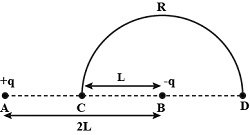
- 2Charges $+q$ and $-q$ are placed at points $A$ and $B$ respectively which are a distance $2\,L$ apart, $C$ is the midpoint between $A$ and $B.$ The work done in moving a charge $+Q$ along the semicircle $CRD$ isView Solution
- 3Two identical thin metal plates has charge $q _{1}$ and $q _{2}$ respectively such that $q _{1}> q _{2}$. The plates were brought close to each other to form a parallel plate capacitor of capacitance $C$. The potential difference between them is.View Solution
- 4View SolutionWhen a dielectric material is introduced between the plates of a charged condenser then electric field between the plates
- 5A condenser of $2\,\mu F$ capacitance is charged steadily from $0$ to $5\,C$. Which of the following graph represents correctly the variation of potential difference $(V)$ across it's plates with respect to the charge $(Q)$ on the condenser?View Solution
- 6Ten charges are placed on the circumference of a circle of radius $R$ with constant angular separation between successive charges. Alternate charges $1,3,5,7,9$ have charge $(+q)$ each, while $2,4,6,8,10$ have charge $(-q)$ each. The potential $V$ and the electric field $E$ at the centre of the circle are respectivelyView Solution
(Take $V =0$ at infinity $)$
- 7In a uniform electric field, the potential is $10$ $V $ at the origin of coordinates, and $8$ $V$ at each of the points $(1, 0, 0), (0, 1, 0) $ and $(0, 0, 1)$. The potential at the point $(1, 1, 1)$ will be....$V$View Solution
- 8A parallel plate air capacitor is charged to a potential difference of $V\, volts$. After disconnecting the charging battery, the distance between the plates of the capacitor is increased using an insulating handle. As a result, the potential difference between the platesView Solution
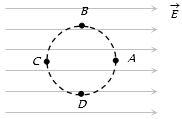
- 9The electric field in a region surrounding the origin is uniform and along the $x$ - axis. A small circle is drawn with the centre at the origin cutting the axes at points $A, B, C, D$ having co-ordinates $(a, 0), (0, a), (-a, 0), (0, -a)$; respectively as shown in figure then potential in minimum at the pointView Solution
- 10Two concentric hollow metallic spheres of radii $r_1$ and $r_2 (r_1 > r_2)$ contain charges $q_1$ and $q_2$ respectively. The potential at a distance $x$ between $r_1$ and $r_2$ will beView Solution