The capacitance of a parallel plate condenser does not depend on
Easy
Download our app for free and get started
Formula used
capacitance $c=\frac{q}{v}$
capacitance of a parallel plate capacitor is given as
$c=\frac{k \varepsilon_0 A}{d}$
The capacitance of the condensor does not depend upon metal of the plates

Download our appand get started for free
Experience the future of education. Simply download our apps or reach out to us for more information. Let's shape the future of learning together!No signup needed.*
Similar Questions
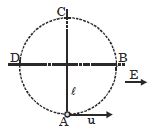
- 1A simple pendulum with a bob of mass $m = 1\ kg$ , charge $q = 5\mu C$ and string length $l = 1\ m$ is given a horizontal velocity $u$ in a uniform electric field $E = 2 × 10^6\ V/m$ at its bottom most point $A$ , as shown in figure. It is given a speed $u$ such that the particle leave the circular path at its topmost point $C$ . Find the speed $u$ . (Take $g = 10\ m/s^2$ )View Solution
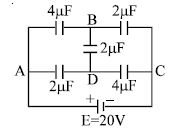
- 2The figure shows a diagonal symmetric arrangement of capacitors and a battery. The potential of the point $B$ and $D$ areView Solution
- 3A conducting sphere $A$ of radius $a$, with charge $Q$, is placed concentrically inside a conducting shell $B$ of radius $b$. $B$ is earthed. $C$ is the common centre of the $A$ and $B$.View Solution

- 4If potential (in volts) in a region is expressed as $V (x,y,z) =6xy-y+2yz $ the electric field (in $N/C$) at point $(1, 1, 0)$ isView Solution
- 5A metallic sphere has a charge of $10\,\mu C$. A unit negative charge is brought from $A$ to $B$ both $100\,cm$ away from the sphere but $A$ being east of it while $B$ being on west. The net work done is........$joule$View Solution
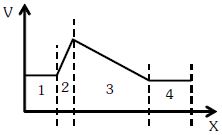
- 6In which region magnitude of $x$ -component of electric field is maximum, if potential $(V)$ versus distance $(X)$, graph is as shown?View Solution
- 7A parallel plate capacitor is connected to a battery. The plates are pulled apart with a uniform speed. If $x$ is the separation between the plates, the time rate of change of electrostatic energy of capacitor is proportional toView Solution
- 8If identical charges $( - q)$ are placed at each corner of a cube of side $b$, then electric potential energy of charge $( + q)$ which is placed at centre of the cube will beView Solution
- 9$1000$ small water drops each of radius $r$ and charge $q$ coalesce together to form one spherical drop. The potential of the big drop is larger than that of the smaller drop by a factor ofView Solution
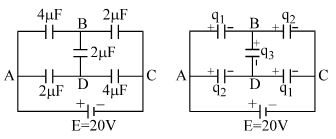
- 10The value of charge $q_1, q_2$ and $q_3$ as shown in the figure areView Solution