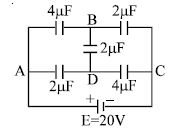
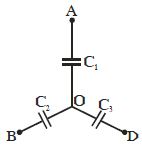
The figure shows a diagonal symmetric arrangement of capacitors and a battery. The potential of the point $B$ and $D$ are
Diffcult


Download our appand get started for free
Experience the future of education. Simply download our apps or reach out to us for more information. Let's shape the future of learning together!No signup needed.*
Similar Questions
- 1A capacitor of $4\, \mu F$ is connected to a $15\, V$ supply through $1$ mega ohm resistance. The time taken by the capacitor to charge upto $63.2\%$ of its final charge will be......$s$View Solution
- 2Two metallic spheres of radii $1\,\, cm$ and $3\,\, cm$ are given, charges of $-1$$ \times {10^{ - 2}}$ $C$ and $5$$ \times {10^{ - 2}}\,C$ respectively. If these are connected by a conducting wire, the final charge on the bigger sphere isView Solution
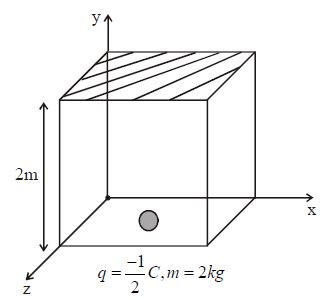
- 3Consider a gravity free container as shown. System is initially at rest and electric potential in the regon is $V = (y^3+2)\ J/C$. A ball of charge $q$ and mass $m$ is released from rest from base starts to move up due to electric field and collides with the shaded face as shown.If its speed just after collision is $1.5\ m/s$ and time for which ball is in contact with shaded face is $0.1\ sec$, find external force required to hold the container fixed in its position during collision assuming ball exerts constant force on wall during entire span of collision.......$N$View Solution
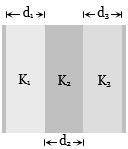
- 4The expression for the capacity of the capacitor formed by compound dielectric placed between the plates of a parallel plate capacitor as shown in figure, will be (area of plate $ = A$)View Solution
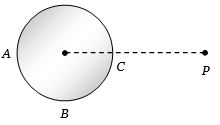
- 5A hollow conducting sphere is placed in an electric field produced by a point charge placed at $P$ as shown in figure. Let ${V_A},{V_B},{V_C}$ be the potentials at points $A,B$ and $C$ respectively. ThenView Solution
- 6Sixty-four drops are jointed together to form a bigger drop. If each small drop has a capacitance $C$, a potential $V$, and a charge $q$, then the capacitance of the bigger drop will beView Solution
- 7The distance between the plates of a parallel plate condenser is $\,4mm$ and potential difference is $60\;volts$. If the distance between the plates is increased to $12\,mm$, thenView Solution
- 8If an electron enters into a space between the plates of a parallel plate capacitor at an angle $\alpha $ with the plates and leaves at an angle $\beta $ to the plates, the ratio of its kinetic energy while entering the capacitor to that while leaving will beView Solution
- 9Three uncharged capacitors of capacitance $C_1$, $C_2$ and $C_3$ are connected as shown in figure to one another and to points $A$, $B$ and $D$ at potentials $V_A$, $V_B$ and $V_D$. Then the potential at $O$ will beView Solution
- 10View SolutionA parallel plate air-core capacitor is connected across a source of constant potential difference. When a dielectric plate is introduced between the two plates then :