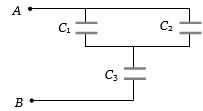
The capacitor of capacitance $4\,\mu F$ and $6\,\mu F$ are connected in series. A potential difference of $500\;volts$ is applied to the outer plates of the two capacitor system. The potential difference across the plates of capacitor of $4\,\mu F$ capacitance is.........$volts$
Easy
Download our app for free and get started
(b) Potential difference across $4\,F$ capacitor
$V = \left( {\frac{6}{{4 + 6}}} \right) \times 500 = 300\,volt$
$V = \left( {\frac{6}{{4 + 6}}} \right) \times 500 = 300\,volt$

Download our appand get started for free
Experience the future of education. Simply download our apps or reach out to us for more information. Let's shape the future of learning together!No signup needed.*
Similar Questions
- 1At the centre of a half ring of radius $R=10 \mathrm{~cm}$ and linear charge density $4 \mathrm{n} \mathrm{C} \mathrm{m}^{-1}$, the potential is $x \pi V$. The value of $x$ is . . . . .View Solution
- 2If three capacitors each of capacity $1\,\mu F$ are connected in such a way that the resultant capacity is $1.5\,\mu F$, thenView Solution
- 3If $4 \times {10^{20}}eV$ energy is required to move a charge of $0.25$ coulomb between two points. Then what will be the potential difference between them......$V$View Solution
- 4If a charged spherical conductor of radius $10\,cm$ has potential $V$ at a point distant $5\,cm$ from its centre, then the potential at a point distant $15\,cm$ from the centre will beView Solution
- 5Find the potential $V$ of an electrostatic field $\vec E = a\left( {y\hat i + x\hat j} \right)$, where $a$ is a constant.View Solution
- 6In the $R-C$ circuit shown in the figure the total energy of $3.6 \times 10^{-3}\ J$ is dissipated in the $10$ $\Omega$ resistor when the switch $S$ is closed. The initial charge on the capacitor is.....$\mu C$View Solution

- 7Two capacitors of capacitances $C$ and $2\, C$ are charged to potential differences $V$ and $2\, V$, respectively. These are then connected in parallel in such a manner that the positive terminal of one is connected to the negative terminal of the other. The final energy of this configuration is$.....CV^2$View Solution
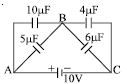
- 8View SolutionIn the circuit shown in figure, four capacitors are connected to a battery. A capacitor is connected to a battery. The force of attraction between the plates when the separation between them is halved
- 9Assertion : If the distance between parallel plates of a capacitor is halved and dielectric constant is three times, then the capacitance becomes $6\,times$.View Solution
Reason : Capacity of the capacitor does not depend upon the nature of the material.
- 10In the given network capacitance, ${C_1} = 10\,\mu \,F,\,{C_2} = 5\,\mu \,F$ and ${C_3} = 4\,\mu \,F$. What is the resultant capacitance between $A$ and $B$.......$\mu \,F$View Solution