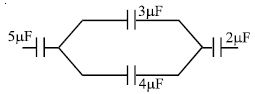
If $4 \times {10^{20}}eV$ energy is required to move a charge of $0.25$ coulomb between two points. Then what will be the potential difference between them......$V$
Easy
Download our app for free and get started
(b) By using, $KE = QV ==> 4 × 10^{20} × 1.6× 10^{-19}$
$= 0.25 × V ==> V = 256\, volt$
$= 0.25 × V ==> V = 256\, volt$

Download our appand get started for free
Experience the future of education. Simply download our apps or reach out to us for more information. Let's shape the future of learning together!No signup needed.*
Similar Questions
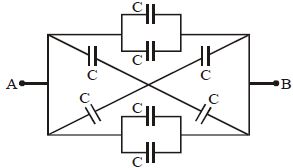
- 1Eight capacitors each of capacitance of $C$ are connected as shown in the figure. The effective capacitance between $A$ and $B$ isView Solution
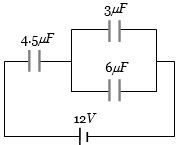
- 2In the circuit shown in the figure, the potential difference across the $4.5\,\mu F$ capacitor is.......$volts$View Solution
- 3Two metallic plates form a parallel plate capacitor. The distance between the plates is $'d'.$ A metal sheet of thickness $\frac{d}{2}$ and of area equal to area of each plate is introduced between the plates. What will be the ratio of the new capacitance to the original capacitance of the capacitor $?$View Solution
- 4A sphere of radius $1\,cm$ has potential of $8000\,V$, then energy density near its surface will beView Solution
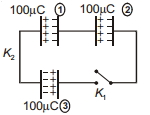
- 5Three identical charged capacitors each of capacitance $5 \,\mu F$ are connected as shown in figure. Potential difference across capacitor $(3)$, long time after the switches $K_1$ and $K_2$ are is closed, is ............ $V$View Solution
- 6The plates of a capacitor are charged to a potential difference of $320 \, volts$ and are then connected across a resistor. The potential difference across the capacitor decays exponentially with time. After $1 $ second the potential difference between the plates of the capacitor is $240 \, volts$, then after $2$ and $3$ seconds the potential difference between the plates will beView Solution
- 7A thin metal plate $P$ is inserted half way between the plates of a parallel plate capacitor of capacitance $C$ in such a way that it is parallel to the two plates. The capacitance now becomesView Solution
- 8The figure shows an experimental plot for discharging of a capacitor in an $R-C$ circuit. The time constant $\tau$ of this circuit lies betweenView Solution
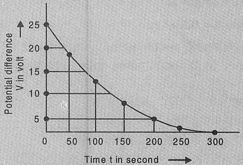
- 9A $5.0\, \mu F$ capacitor is charged to a potential difference $800\, V$ and discharged through a conductor. The energy(in $J$) given to a conductor during the discharge isView Solution
- 10If charge on left plane of the $5\ \mu F$ capacitor in the circuit segment shown in the figure is $-20\ \mu C$, the charge on the right plate of $3\ \mu F$ capacitor is.......$ \mu C$View Solution