If a charged spherical conductor of radius $10\,cm$ has potential $V$ at a point distant $5\,cm$ from its centre, then the potential at a point distant $15\,cm$ from the centre will be
Easy
Download our app for free and get started
(b) Potential inside the sphere will be same as that on its surface i.e. $V = {V_{surface}} = \frac{q}{{10}}stat\,volt$, ${V_{out}} = \frac{q}{{15}}stat\,volt$
$\frac{{{V_{out}}}}{V} = \frac{2}{3}$ $==>$ ${V_{out}} = \frac{2}{3}\,V$
$\frac{{{V_{out}}}}{V} = \frac{2}{3}$ $==>$ ${V_{out}} = \frac{2}{3}\,V$

Download our appand get started for free
Experience the future of education. Simply download our apps or reach out to us for more information. Let's shape the future of learning together!No signup needed.*
Similar Questions
- 1A charge $Q$ is distributed over three concentric spherical shell of radii $a, b, c (a < b < c)$ such that their surface charge densities are equal to one another. The total potential at a point at distance $r$ from their common centre, where $r < a$, would beView Solution
- 2The plates of a capacitor are charged to a potential difference of $320 \, volts$ and are then connected across a resistor. The potential difference across the capacitor decays exponentially with time. After $1 $ second the potential difference between the plates of the capacitor is $240 \, volts$, then after $2$ and $3$ seconds the potential difference between the plates will beView Solution
- 3View SolutionA capacitor is charged by using a battery which is then disconnected. A dielectric slab is then slipped between the plates, which results in
- 4View SolutionTwo identical conductors of copper and aluminium are placed in an identical electric fields. The magnitude of induced charge in the aluminium will be
- 5A spherical metal shell $A$ of radius $R_A$ and a solid metal sphere $B$ of radius $R_B\left( < R_A\right)$ are kept far apart and each is given charge ' $+Q$ '. Now they are connected by a thin metal wire. ThenView Solution
$(A)$ $E_A^{\text {lnside }}=0$
$(B)$ $Q_A > Q_B$
$(C)$ $\frac{\sigma_A}{\sigma_B}=\frac{R_B}{R_A}$
$(D)$ $E_A^{\text {on sulface }} < E_B^{\text {on uurface }}$
- 6A parallel plate capacitor is made by stacking $n$ equally spaced plates connected alternately. If the capacitance between any two plates is $C$ then the resultant capacitance isView Solution
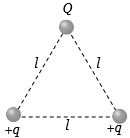
- 7Three charges $Q,( + q)$ and $( + q)$ are placed at the vertices of an equilateral triangle of side l as shown in the figure. If the net electrostatic energy of the system is zero, then $Q$ is equal toView Solution
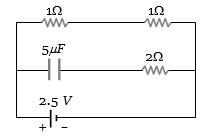
- 8A capacitor of capacitance $5\,\mu F$ is connected as shown in the figure. The internal resistance of the cell is $0.5\,\Omega $. The amount of charge on the capacitor plate is......$\mu C$View Solution
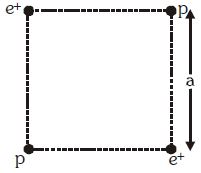
- 9Two positrons $(e^+)$ and two protons $(p)$ are kept on four corners of a square of side $a$ as shown in figure. The mass of proton is much larger than the mass of positron. Let $q$ denotes the charge on the proton as well as the positron then the kinetic energies of one of the positrons and one of the protons respectively after a very long time will be-View Solution
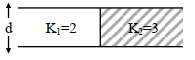
- 10A capacitor of $10 \mu \mathrm{F}$ capacitance whose plates are separated by $10 \mathrm{~mm}$ through air and each plate has area $4 \mathrm{~cm}^2$ is now filled equally with two dielectric media of $\mathrm{K}_1=2, \mathrm{~K}_2=3$ respectively as shown in figure. If new force between the plates is $8 \mathrm{~N}$. The supply voltage is . . . .. . .V.View Solution