MCQ
The capacitor offers zero resistance to.
  • A
    $D.C$. only
  • B
    $A.C.\ \&\ D.C.$
  • $A.C.$ only
  • D
    neither $A.C.$ nor $D.C.$

Answer

Correct option: C.
$A.C.$ only

Capacitive reactance is given as $\text{X}_\text{C}=\frac{1}{\omega\text{C}}$
From this relation we can see that the value of capacitive reactance and therefore its overall impedance $($in Ohms$)$ decreases to zero as the frequency increases acting like a short
circuit. Likewise, as the frequency approaches zero or $DC$, the capacitors reactance increases to infinity, acting like an open circuit which is why capacitors block $DC.$

Need a full question paper?

Generate a complete, print-ready paper with questions like this in minutes — across 16+ boards, with answer keys.
Start Generating Free

Similar questions

A straight conductor of length $0.4\;m$ is moved with a speed of $7\;m/s$ perpendicular to the magnetic field of intensity of $0.9\;Wb/m^2$. The induced $e.m.f$. across the conductor will be......$V$
Total internal reflection is possible when light rays travel
In a transformer, number of turns in the primary are $140$ and that in the secondary are $280$. If current in primary is $4\,A$ then that in the secondary is.....$A$
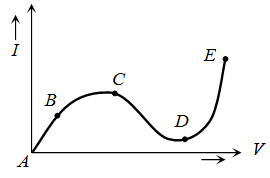
The voltage V and current I graph for a conductor at two different temperatures $\mathrm T_1$ and $\mathrm T_2$ are shown in the figure. The relation between $\mathrm T_1$ and $\mathrm T_2$ is
The work function of aluminium is 4.2 eV. If two photons, each of energy 3.5 eV strike an electron of aluminium, then emission of electrons will be
A copper wire of diameter $1.02\, mm$ carries a current of $1.7\, amp$. Find the drift  velocity $(v_d)$ of electrons in the wire. Given $n$, number density of electrons in copper $= 8.5 \times 10^{27} /m^3$....................... $mm/sec$
Electric field in a region is uniform and is given by $\vec{E}=a \hat{i}+b \hat{j}+c \hat{k}$. Electric flux associated with a surface of area $\vec{A}=\pi R^2 \hat{i}$ is
The potential to which a conductor is raised, depends on
At absolute zero, $Si$ acts as
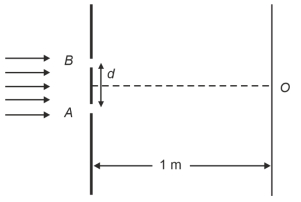
In a Young's double slit experiment, each of the two slits $A$ and $B$, as shown in the figure, are oscillating about their fixed center and with a mean separation of $0.8 mm$. The distance between the slits at time $t$ is given by $d=(0.8+0.04 \sin \omega t) mm$, where $\omega=0.08 rad s ^{-1}$. The distance of the screen from the slits is $1 m$ and the wavelength of the light used to illuminate the slits is $6000 \mathring A$. The interference pattern on the screen changes with time, while the central bright fringe (zeroth fringe) remains fixed at point $O$.

($1$) The $8^{\text {mh }}$ bright fringe above the point $O$ oscillates with time between two extreme positions. The separation between these two extreme positions, in micrometer $(\mu m )$, is. . . . .

($2$) The maximum speed in $\mu m / s$ at which the $8^{\text {th }}$ bright fringe will move is. . . . .

Give the answer or quetion ($1$) and ($2$)