The capacity of a parallel plate condenser is $10\,\mu F$ without dielectric. Dielectric of constant $2$ is used to fill half the distance between the plates, the new capacitance in $\mu F$ is
Medium
Download our app for free and get started
(d) $C = \frac{{A{\varepsilon _0}}}{d} = 10\,\mu F$
${C_1} = \frac{{A{\varepsilon _0}}}{{d - t + \frac{t}{k}}} = \frac{{A{\varepsilon _0}}}{{d - \frac{d}{2} + \frac{d}{{2k}}}} = \frac{{A{\varepsilon _0}}}{{\frac{d}{2}\left( {1 + \frac{1}{2}} \right)}} = \frac{4}{3}.\frac{{A{\varepsilon _0}}}{d}$
${C_1} = \frac{4}{3} \times 10 = 13.33\,\mu F$
${C_1} = \frac{{A{\varepsilon _0}}}{{d - t + \frac{t}{k}}} = \frac{{A{\varepsilon _0}}}{{d - \frac{d}{2} + \frac{d}{{2k}}}} = \frac{{A{\varepsilon _0}}}{{\frac{d}{2}\left( {1 + \frac{1}{2}} \right)}} = \frac{4}{3}.\frac{{A{\varepsilon _0}}}{d}$
${C_1} = \frac{4}{3} \times 10 = 13.33\,\mu F$

Download our appand get started for free
Experience the future of education. Simply download our apps or reach out to us for more information. Let's shape the future of learning together!No signup needed.*
Similar Questions
- 1Four point charges $-Q, -q, 2q$ and $2Q$ are placed, one at each comer of the square. The relation between $Q$ and $q$ for which the potential at the centre of the square is zero isView Solution
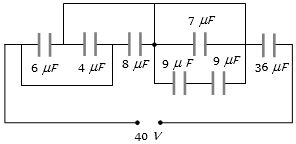
- 2In the following diagram, the charge and potential difference across $8\, \mu F$ capacitance will be respectivelyView Solution
- 3A point charge $2 \times 10^{-2}\,C$ is moved from $P$ to $S$ in a uniform electric field of $30\,NC ^{-1}$ directed along positive $x$-axis. If coordinates of $P$ and $S$ are $(1,2$, $0) m$ and $(0,0,0) m$ respectively, the work done by electric field will be $.........\,mJ$View Solution
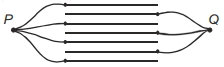
- 4Seven identical plates each of area $A$ and successive separation $d$ are arranged as shown in figures. The effective capacitance of the system between $P$ and $Q$ isView Solution
- 5Two identical capacitors, have the same capacitance $C$. One of them is charged to potential $V_1$ and the other to $V_2$. The negative ends of the capacitors are connected together. When the positive ends are also connected, the decrease in energy of the combined system isView Solution
- 6A $4\, \,\mu F$ condenser is charged to $400\, V$ and then its plates are joined through a resistance. The heat produced in the resistance is.......$J$View Solution
- 7Two charged conducting spheres of radii $a$ and $b$ are connected to each other by a conducting wire. The ratio of charges of the two spheres respectively is:View Solution
- 8Three charges $-q, Q$ and $-q$ are placed respectively at equal distances on a straight line. If the potential energy of the system of three charges is zero, then what is the ratio of $Q: q$ ?View Solution
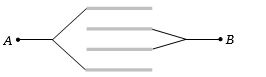
- 9Four plates of equal area $A$ are separated by equal distances $d$ and are arranged as shown in the figure. The equivalent capacity isView Solution
- 10View SolutionAn uncharged capacitor is connected to a battery. On charging the capacitor