The capacity of a vessel is $3$ litres. It contains $6 \,gm$ oxygen, $8\, gm$ nitrogen and $5\, gm$ $C{O_2}$ mixture at $27°C.$ If $R = 8.31\, J/mole$ $ \times $ $kelvin,$ then the pressure in the vessel in $N/{m^2}$ will be (approx.)
Medium


Download our appand get started for free
Experience the future of education. Simply download our apps or reach out to us for more information. Let's shape the future of learning together!No signup needed.*
Similar Questions
- 1A $25\times10^{-3}\, m^3$ volume cylinder is filled with $1\, mol$ of $O_2$ gas at room temperature $(300\, K)$. The molecular diameter of $O_2$, and its root mean square speed, are found to be $0.3\, nm$ and $200\, m/s$, respectively. What is the average collision rate (per second) for an $O_2$ molecule?View Solution
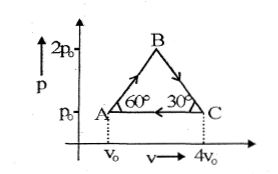
- 2Four moles of an ideal monoatomic gas undergoes a cyclic process $ABCA$ as shown in figure find ratio of temperature of $A$ and $B$ .View Solution
- 3An ideal gas with adiabatic exponent $(\gamma=1.5)$ undergoes a process in which work done by the gas is same as increase in internal energy of the gas. The molar heat capacity of gas for the process is -View Solution
- 4Consider a $1\, c.c.$ sample of air at absolute temperature ${T_0}$ at sea level and another $1 cc$ sample of air at a height where the pressure is one-third atmosphere. The absolute temperature $T$ of the sample at that height isView Solution
- 5A vessel contains a mixture of one mole of oxygen and two moles of nitrogen at $300\ K.$ The ratio of the average rotational kinetic energy per $O_2$ molecule to that per $N_2$ molecule isView Solution
- 6View SolutionIt is possible for a substance to coexist in all three phases in equilibrium, when the substance is at
- 7The average translational kinetic energy of a hydrogen gas molecules at $NTP$ will beView Solution
[Boltzmann’s constant ${k_B} = 1.38 \times {10^{ - 23}}J/K]$
- 8The mean kinetic energy of a gas at $300 K$ is $100 J.$ The mean energy of the gas at $450 K$ is equal to ...... $J$View Solution
- 9$N( < 100)$ molecules of a gas have velocities $1, 2, 3\,.\,.\,.\,.\,.N/km/s$ respectively. ThenView Solution
- 10Volume-temperature graph at atmospheric pressure for a monoatomic gas $(V\,{\rm{in }}{m^3},\,\,T\,{\rm{in}}{{\rm{ }}^{\rm{o}}}C)$ isView Solution