MCQ
The cellular mobile radio frequency band is:
  • A
    88 – 108 MHz
  • B
    54 – 72 MHz
  • C
    540 – 1600 KHz
  • D
    840 – 935 MHz

Answer

  1. 840 – 935 MHz

Need a full question paper?

Generate a complete, print-ready paper with questions like this in minutes — across 16+ boards, with answer keys.

Start Generating Free

Similar questions

When the number of nucleons in a nucleus increases, the binding energy per nucleon:
A wall clock uses a vertical spring-mass system to measure the time. Each time the mass reaches an extreme position, the clock advances by a second. The clock gives correct time at the equator. If the clock is taken to the poles it will:
  1. Run slow.
  2. Run fast.
  3. Stop working.
  4. Give correct time.
A positively charged particle moving in east direction enters a region of uniform magnetic field directed vertically upwards. What will be the path of the particle?

The potential gradient at which the dielectric of a condenser just gets punctured is called

(a) Dielectric constant

(b) Dielectric strength

(c) Dielectric resistance

(d) Dielectric number

If the voltage of X-ray tube is doubled, the intensity of X-rays will become

(a) Half

(b) Unchanged

(c) Double

(d) Four times

During mean life of a radioactive element, the fraction that disintegrates is

(a) e 

(b)  

(c)  

(d)  

No. of protons and neutrons in hydrogen atom are respectively __________ .
The capacity of the parallel plate capacitor increases when:
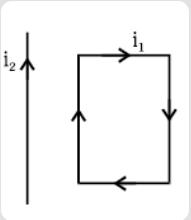
A rectangular loop carrying a current i1​, is situated near a long straight wire carrying a steady current i2​. The wire is parallel to one of the sides of the loop and is in the plane of the loop as shown in the figure. Then the current loop will:

X-rays of wavelength 0.1 Å allowed to fall on a metal get scattered. The wavelength of scattered radiation is 0.111 Å. If h = 6.624 × 10⁻³⁴ J-s and m0 = 9 × 10–31 kg, then the direction of the scattered photons will be

(a) cos–1 (0.547)

(b) cos–1 (0.4484)

(c) cos–1 (0.5)

(d) cos–1 (0.3)