MCQ
The centripetal acceleration is given by
  • $v^2/r$
  • B
    $vr$
  • C
    $vr^2$
  • D
    $v/r$

Answer

Correct option: A.
$v^2/r$
a
(a)

Need a full question paper?

Generate a complete, print-ready paper with questions like this in minutes — across 16+ boards, with answer keys.

Start Generating Free

Similar questions

Steam at $100^o C$ is added slowly to $1400 \,\,gm$ of water at $16^o C$ until the temperature of water is raised to $80^o C$. The mass of steam required to do this is ($L_V =$  $540\,\,cal/gm$) ........... $gm$
The maximum speed that can be achieved without skidding by a car on a circular unbanked road of radius $R$ and coefficient of static friction $\mu $, is
A particle is moving in a circular path of radius $r$ under the action of a force $F$. If at an instant velocity of particle is $v$, and speed of particle is increasing, then
The surface area of a solid cylinder of radius 2.0cm and height A cm is equal to 1.5 × 104(mm)2. Here, A refers to:
A vibratory motion is represented by $x = 2A\,\cos \omega t + A\,\cos \,\left( {\omega t + \frac{\pi }{2}} \right) + A\,\cos \,\left( {\omega t + \pi } \right)$ $ + \frac{A}{2}\,\cos \left( {\omega t + \frac{{3\pi }}{2}} \right)$. The resultant amplitude of the motion is
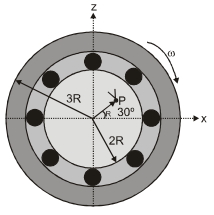
The figure shows a system consisting of $(i)$ a ring of outer radius $3 \ R$ rolling clockwise without slipping on a horizontal surface with angular speed $\omega$ and $(ii)$ an inner disc of radius $2 \ R$ rotating anti-clockwise with angular speed $\omega / 2$. The ring and disc are separated $b$ frictionaless ball bearings. The system is in the $x-z$ plane. The point $P$ on the inner disc is at distance $R$ from the origin, where $OP$ makes an angle of $30^{\circ}$ with the horizontal. Then with respect to the horizontal surface, $Image$

$(A)$ the point $O$ has linear velocity $3 R \omega \hat{ i }$.

$(B)$ the point $P$ has a linear velocity $\frac{11}{4} R \omega \hat{ i }+\frac{\sqrt{3}}{4} R \omega \hat{ k }$

$(C)$ the point $P$ has linear velocity $\frac{13}{4} R w \hat{ i }-\frac{\sqrt{3}}{4} R \omega \hat{k}$

$(D)$ The point $P$ has a linear velocity $\left(3-\frac{\sqrt{3}}{4}\right) R w_{\hat{ i }}+\frac{1}{4} R w_{\hat{k}}$.
If the mass of the earth is doubled and its radius halved, then new acceleration due to the gravity g’ is:
A projectile cover double range as compare to its maximum height attained. The angle of  projection is
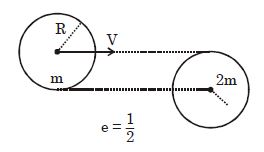
A ball of mass $m$ is moving with a speed $V$ as shown in the figure. It undergoes inelastic collision with a ball of mass $2\ m$ which was initially at rest. The velocity of ball $2\ m$ after collision will be given by
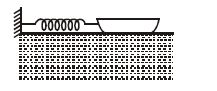
A steady force of $120\ N$ is required to push a boat of mass $700\ kg$ through water at a constant speed of $1\ m/s$ . If the boat is fastened by a spring and held at $2\ m$ from the equilibrium position by a force of $450\ N$ , find the angular frequency of damped $SHM$  ..... $rad/s$