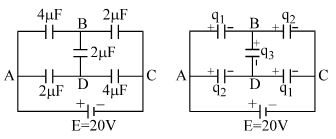
The charge deposited on $4\,\mu F$ capacitor in the circuit is
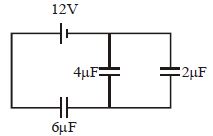
Medium

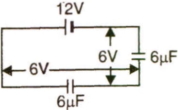

Download our appand get started for free
Experience the future of education. Simply download our apps or reach out to us for more information. Let's shape the future of learning together!No signup needed.*
Similar Questions
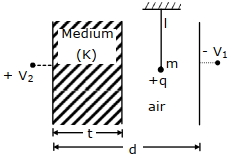
- 1A simple pendulum of mass $'m',$ length $'I'$ and charge $'+q'$ suspended in the electric field produced by two conducting parallel plates as shown. The value of deflection of pendulum in equilibrium position will be -View Solution
- 2The equivalent capacitance between points $A$ and $B$ in below shown figure will be..........$\mu F$.View Solution
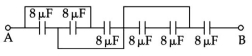
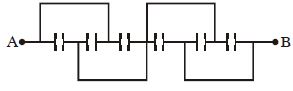
- 3All capacitors used in the diagram are identical and each is of capacitance $C$. Then the effective capacitance between the points $A$ and $B$ isView Solution
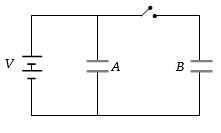
- 4Figure given below shows two identical parallel plate capacitors connected to a battery with switch $S$ closed. The switch is now opened and the free space between the plate of capacitors is filled with a dielectric of dielectric constant $3$. What will be the ratio of total electrostatic energy stored in both capacitors before and after the introduction of the dielectricView Solution
- 5An electric dipole of moment $\vec p$ is kept in a uniform electric field $\vec E$. Angle between $\vec p$ and $\vec E$ is $30^o$. Calculate work done by field when angle is increased to $60^o.$View Solution
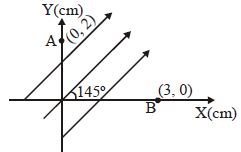
- 6A uniform electric field of $400 \,v/m$ is directed $45^o$ above the $x$ - axis. The potential difference $V_A - V_B$ is -.....$V$View Solution
- 7The capacitance of a parallel plate capacitor is $C$ when the region between the plate has air. This region is now filled with a dielectric slab of dielectric constant $k$. The capacitor is connected to a cell of $emf$ $E$, and the slab is taken outView Solution
- 8Three capacitors each of capacitance $1\,\mu F$ are connected in parallel. To this combination, a fourth capacitor of capacitance $1\,\mu F$ is connected in series. The resultant capacitance of the system is.......$\mu F$View Solution
- 9The plates of a capacitor are charged to potential difference of $V\, volts$ and then connected across a resistor. The potential difference across the capacitor decreases exponentially with respect to time. After one second, the potential difference between the plates is $V/3$; then after two seconds from the start, the potential difference between the plates isView Solution
- 10The value of charge $q_1, q_2$ and $q_3$ as shown in the figure areView Solution