The plates of a capacitor are charged to potential difference of $V\, volts$ and then connected across a resistor. The potential difference across the capacitor decreases exponentially with respect to time. After one second, the potential difference between the plates is $V/3$; then after two seconds from the start, the potential difference between the plates is
Medium
Download our app for free and get started
$\frac{V}{3}=V \cdot e^{-1 / R C}$ or $e^{-1 / R C}=\frac{1}{3}$
$\mathrm{V}^{\prime}=\mathrm{Ve}^{-2 / \mathrm{RC}}=\mathrm{V}\left(\mathrm{e}^{-1 / \mathrm{RC}}\right)^{2}$
$=V\left(\frac{1}{3}\right)^{2}=\frac{V}{9}$

Download our appand get started for free
Experience the future of education. Simply download our apps or reach out to us for more information. Let's shape the future of learning together!No signup needed.*
Similar Questions
- 1Consider three concentric metallic spheres $A, B$ and $C$ of radii $a , b, c$, respectively where $a < b < c$. $A$ and $B$ are connected, whereas $C$ is grounded. The potential of the middle sphere $B$ is raised to $V$, then the charge on the sphere $C$ isView Solution
- 2Two hollow conducting spheres of radii $R_{1}$ and $R_{2}$ $\left(R_{1}>>R_{2}\right)$ have equal charges. The potential would be:View Solution
- 3Two small equal point charges of magnitude $q$ are suspended from a common point on the ceiling by insulating mass less strings of equal lengths. They come to equilibrium with each string making angle $\theta $ from the vertical. If the mass of each charge is $m,$ then the electrostatic potential at the centre of line joining them will be $\left( {\frac{1}{{4\pi { \in _0}}} = k} \right).$View Solution
- 4$27$ similar drops of mercury are maintained at $10 \,V$ each. All these spherical drops combine into a single big drop. The potential energy of the bigger drop is ....... times that of a smaller drop.View Solution
- 5A parallel plate capacitor of capacitance $200 \,\mu {F}$ is connected to a battery of $200 \, {V} .$ A dielectric slab of dielectric constant $2$ is now inserted into the space between plates of capacitor while the battery remain connected. The change in the electrostatic energy in the capacitor will be ......$ J.$View Solution
- 6An electron of mass $m$ and charge $e$ is accelerated from rest through a potential difference $V$ in vacuum. Its final velocity will beView Solution
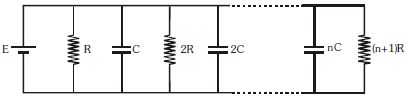
- 7For shown situation, in steady state condition ratio of charge stored in the first and last $n^{th}$ capacitor isView Solution
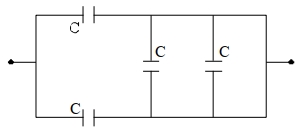
- 8View SolutionThe equivalent capacitance of the combination shown is
- 9Three charges $2 q,-q$ and $-q$ are located at the vertices of an equilateral triangle. At the center of the triangleView Solution
- 10$0.2\, F$ capacitor is charged to $600\, V$ by a battery. On removing the battery. It is connected with another parallel plate condenser of $1\, F$. The potential decreases to....$V$View Solution