The charge on a capacitor plate in a circuit, as a function of time, is shown in the figure
What is the value of current at $t = 4\,s$ ? ............... $\mu A$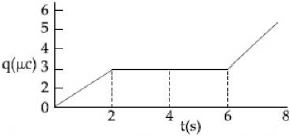
JEE MAIN 2019, Easy


Download our appand get started for free
Experience the future of education. Simply download our apps or reach out to us for more information. Let's shape the future of learning together!No signup needed.*
Similar Questions
- 1The drift velocity of free electrons in a conductor is ‘$v$’ when a current ‘$i$’ is flowing in it. If both the radius and current are doubled, then drift velocity will beView Solution
- 2To measure the internal resistance of a battery, potentiometer is used. For $\mathrm{R}=10 \Omega$, the balance point is observed at $\ell=500 \mathrm{~cm}$ and for $\mathrm{R}=1 \Omega$ the balance point is observed at $\ell=400 \mathrm{~cm}$. The internal resistance of the battery is approximately :View Solution
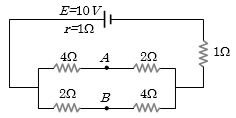
- 3In the circuit shown below, the cell has an $e.m.f.$ of $10\,V$ and internal resistance of $1\, ohm$. The other resistances are shown in the figure. The potential difference ${V_A} - {V_B}$ is ................ $V$View Solution
- 4A source of $e.m.f.$ $E = 15\,V$ and having negligible internal resistance is connected to a variable resistance so that the current in the circuit increases with time as $i = 1.2 t + 3$. Then, the total charge that will flow in first five second will be ............... $C$View Solution
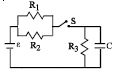
- 5The circuit shown in the figure consists of a battery of $emf$ $\varepsilon = 10 \,V$ ; a capacitor of capacitance $C = 1.0$ $ \mu F$ and three resistor of values $R_1 = 2$ $\Omega$ , $R_2 = 2$ $\Omega$ and $R_3 = 1$ $\Omega$ . Initially the capacitor is completely uncharged and the switch $S$ is open. The switch $S$ is closed at $t = 0.$View Solution
- 6A bulb has specification of one kilowatt and $250\, volts$, the resistance of bulb is .................. $\Omega$View Solution
- 7View SolutionA conductor behaves as a superconductor
- 8A cell can be balanced against $110\,\, cm$ and $100\,\, cm$ of potentiometer wire, respectively with and without being short circuited through a resistance of $10 \,\,\Omega$. Its internal resistance is ............... $\Omega$View Solution
- 9The charge flowing through a resistance $R$ varies with time according to $Q = at -bt^2.$ The total heat produced in $R$ is : (assume that direction of current not reversed)View Solution
- 10A $25\, watt$, $220\, volt$ bulb and a $100\, watt$, $220\, volt$ bulb are connected in series across a $220\, volt$ lines. Which electric bulb will glow more brightlyView Solution