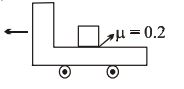
The coefficient of friction between the tyres and the road is $0.25$. The maximum speed with which a car can be driven round a curve of radius $40 \,m$ without skidding is ........ $ms^{-1}$ (assume $g = 10 \,ms^{-2}$)
Easy


Download our appand get started for free
Experience the future of education. Simply download our apps or reach out to us for more information. Let's shape the future of learning together!No signup needed.*
Similar Questions
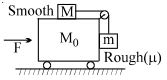
- 1Imagine $a$ situation in which the horizontal surface of block $M_0$ is smooth and its vertical surface is rough with $a$ coefficient of friction $\mu$ In above problem, the value $(s)$ of $F$ for which $M$ and $m$ are stationary with respect to $M_0 mg$View Solution
- 2A car turns a corner on a slippery road at a constant speed of $10\,m/s$. If the coefficient of friction is $0.5$, the minimum radius of the arc in meter in which the car turns isView Solution
- 3If a ladder weighing $250\,N$ is placed against a smooth vertical wall having coefficient of friction between it and floor is $0.3$, then what is the maximum force of friction available at the point of contact between the ladder and the floor ........ $N$View Solution
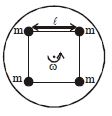
- 4Four identical point masses $'m'$ joined by light string of length $'l'$ arrange such that they form square frame. Centre of table is coincide with centre of arrangment. If arrangement rotate with constant angular velocity $'\omega '$ , find out tension in each stringView Solution
- 5View SolutionIf the normal force is doubled, the coefficient of friction is
- 6A cyclist is travelling with velocity $v$ on a curved road of radius $R$. The angle $\theta$ through which the cyclist leans inwards is given byView Solution
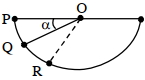
- 7A ball is released from rest from point $P$ of a smooth semi-spherical vessel as shown in figure. The ratio of the centripetal force and normal reaction on the ball at point $Q$ is $A$ while angular position of point $Q$ is $\alpha$ with respect to point $P$. Which of the following graphs represent the correct relation between $A$ and $\alpha$ when ball goes from $Q$ to $R$ ?View Solution
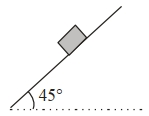
- 8Consider a block kept on an inclined plane (inclined at $45^{\circ}$ ) as shown in the figure. If the force required to just push it up the incline is $2$ times the force required to just prevent it from sliding down, the coefficient of friction between the block and inclined plane $(\mu)$ is equal toView Solution
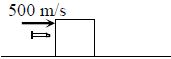
- 9A bullet of mass $20\, g$ travelling horizontally with a speed of $500 \,m/s$ passes through a wooden block of mass $10.0 \,kg$ initially at rest on a surface. The bullet emerges with a speed of $100\, m/s$ and the block slides $20 \,cm$ on the surface before coming to rest, the coefficient of friction between the block and the surface. $(g = 10\, m/s^2)$View Solution
- 10A truck starting from rest moves with an acceleration of $5 m/s^2$ for $1 sec$ and then moves with constant velocity. The velocity $w.r.t$ ground $v/s$ time graph for block in truck is ( Assume that block does not fall off the truck)View Solution