A cyclist is travelling with velocity $v$ on a curved road of radius $R$. The angle $\theta$ through which the cyclist leans inwards is given by
Medium


Download our appand get started for free
Experience the future of education. Simply download our apps or reach out to us for more information. Let's shape the future of learning together!No signup needed.*
Similar Questions
- 1A body of mass $40\,kg$ resting on rough horizontal surface is subjected to a force $P$ which is just enough to start the motion of the body. If $\mu_{ s }=5, \mu_{ x }=0.4$, $g =10\,m / s ^2$ and the force $P$ is continuously applied on the body, then the acceleration of the body is $.........m/s^{2}$View Solution
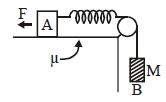
- 2Block $A$ of mass $m$ and block $B$ of mass $M$ are connected by a massless spring over a pulley on a rough plane with coefficient of friction as $μ$. A force $F$ is applied on block $A$ to the left. Find the minimum value of $M$ to move the block $A$ towards rightView Solution
- 3A body starts from rest on a long inclined plane of slope $45^o$ . The coefficient of friction between the body and the plane varies as $\mu = 0.3\,x$ . where $x$ is distance travelled down the plane. The body will have maximum speed ( for $g = 10\,m/s^2$ ) when $x=$ ........ $m$View Solution
- 4A block of mass $m$ is placed on a surface having vertical cross section given by $y=x^2 / 4$. If coefficient of friction is $0.5$ , the maximum height above the ground at which block can be placed without slipping is:View Solution
- 5A curved in a level road has a radius $75\, m$. The maximum speed of a car turning this curved road can be $30 \,m / s$ without skidding. If radius of curved road is changed to $48\, m$ and the coefficient of friction between the tyres and the road remains same, then maximum allowed speed would be .........$m / s$.View Solution
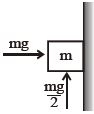
- 6View SolutionA block pressed against the vertical wall is in equilibrium. The minimum coefficient of friction is:-
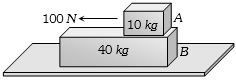
- 7A $40 \,kg$ slab rests on a frictionless floor as shown in the figure. A $10 \,kg$ block rests on the top of the slab. The static coefficient of friction between the block and slab is $0.60$ while the kinetic friction is $0.40$. The $10\, kg$ block is acted upon by a horizontal force $100 \,N$. If $g = 9.8\,m/{s^2}$, the resulting acceleration of the slab will be ........ $m/s^2$View Solution
- 8View SolutionIf the overbridge is concave instead of being convex, the thrust on the road at the lowest position will be
- 9A block of mass $m$ is placed on a surface with a vertical coss section given by $y = \frac{{{x^3}}}{6}$ . If the coefficient of friction is $0.5$, the maximum height above the ground at which the block can be placed without slipping isView Solution
- 10An annular ring with inner and outer radii $R_{1}$ and $R_{2}$ is rolling without slipping with a uniform angular speed. The ratio of the forces experienced by the two particles situated on the inner and outer parts of the ring, $\frac{F_{1}}{F_{2}}$ isView Solution