The coefficient of linear expansion of brass and steel are ${\alpha _1}$ and ${\alpha _2}$. If we take a brass rod of length ${l_1}$ and steel rod of length ${l_2}$ at $0°C$, their difference in length $({l_2} - {l_1})$ will remain the same at a temperature if
Diffcult
Download our app for free and get started
(d) ${L_2} = {l_2}(1 + {\alpha _2}\Delta \theta )$ and ${L_1} = {l_1}(1 + {\alpha _1}\Delta \theta )$
$ \Rightarrow ({L_2} - {L_1}) = ({l_2} - {l_1}) + \Delta \theta ({l_2}{\alpha _2} - {l_1}{\alpha _1})$
Now $({L_2} - {L_1}) = ({l_2} - {l_1})$ so, ${l_2}{\alpha _2} - {l_1}{\alpha _1} = 0$

Download our appand get started for free
Experience the future of education. Simply download our apps or reach out to us for more information. Let's shape the future of learning together!No signup needed.*
Similar Questions
- 1The lengths and radii of two rods made of same material are in the ratios $1 : 2$ and $2 : 3$ respectively. If the temperature difference between the ends for the two rods be the same, then in the steady state, the amount of heat flowing per second through them will be in the ratioView Solution
- 2A black body at $1227^o C$ emits radiations with maximum intensity at a wavelength of $5000\;\mathring A$ . If the temperature of the body is increased by $1000^o C$, the maximum intensity will be observed at ...... $\mathring A$View Solution
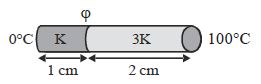
- 3Two bars of thermal conductivities $K$ and $3K$ and lengths $1\,\, cm$ and $2\,\, cm$ respectively have equal cross-sectional area, they are joined lengths wise as shown in the figure. If the temperature at the ends of this composite bar is $0\,^oC$ and $100\,^oC$ respectively (see figure), then the temperature $\varphi $ of the interface is......... $^oC$View Solution
- 4Assuming the Sun to be a spherical body of radius $R$ at a temperature of $T\ K$, evaluate the total radiant powerd incident of Earth at a distance $r$ from the SunView Solution
Where $r_{0}$ is the radius of the earth and $\sigma$ is Stefan's constant.
- 5A sphere of ice at $0^o C$ having initial radius $R$ is placed in an environment having ambient temperature $> 0^o C$. The ice melts uniformly, such that shape remains spherical. After a time $‘t’$ the radius of the sphere has reduced to$r$. Assuming the rate of heat absorption is proportional to the surface area of the sphere at any moment, which graph best depicts $r (t)$.View Solution
- 6A hot body, obeying Newton's law of cooling is cooling down from its peak value $80\,^oC$ to an ambient temperature of $30\,^oC$ . It takes $5\, minutes$ in cooling down from $80\,^oC$ to $40\,^oC$. ........ $\min.$ will it take to cool down from $62\,^oC$ to $32\,^oC$ ? (Given $ln\, 2\, = 0.693, ln\, 5\, = 1.609$)View Solution
- 7Relation between emissivity $e$ and absorptive power $a$ is (for black body)View Solution
- 8A body takes $4\, {min}$. to cool from $61^{\circ} {C}$ to $59^{\circ} {C}$. If the temperature of the surroundings is $30^{\circ} {C}$, the time taken by the body to cool from $51^{\circ} {C}$ to $49^{\circ} {C}$ is $....\,min$View Solution
- 9The original temperature of a black body is ${727^o}C.$The temperature at which this black body must be raised so as to double the total radiant energy, is ....... $K$View Solution
- 10Four rods of identical cross-sectional area and made from the same metal form the sides of square. The temperature of two diagonally opposite points and $T$ and $\sqrt 2 $ $T$ respective in the steady state. Assuming that only heat conduction takes place, what will be the temperature difference between other two pointsView Solution