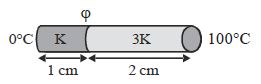
Two bars of thermal conductivities $K$ and $3K$ and lengths $1\,\, cm$ and $2\,\, cm$ respectively have equal cross-sectional area, they are joined lengths wise as shown in the figure. If the temperature at the ends of this composite bar is $0\,^oC$ and $100\,^oC$ respectively (see figure), then the temperature $\varphi $ of the interface is......... $^oC$
Medium


Download our appand get started for free
Experience the future of education. Simply download our apps or reach out to us for more information. Let's shape the future of learning together!No signup needed.*
Similar Questions
- 1A cylinder of radius $R$ is surrounded by a cylindrical shell of inner radius $R$ and outer radius $2R$. The thermal conductivity of the material of the inner cylinder is $K_1$ and that of the outer cylinder is $K_2$. Assuming no loss of heat, the effective thermal conductivity of the system for heat flowing along the length of the cylinder isView Solution
- 2A body takes $T$ minutes to cool from ${62^o}C$ to ${61^o}C$ when the surrounding temperature is ${30^o}C$. The time taken by the body to cool from ${70^o}$ to $({A_1}\,{\rm{and }}{A_{\rm{2}}})$ isView Solution
- 3If the radius of a star is $R$ and it acts as a black body, what would be the temperature of the star, in which the rate of energy production is Q? ( $\sigma$ stands for Stefan's constant.)View Solution
- 4View SolutionIn rainy season, on a clear night the black seat of a bicycle becomes wet because
- 5View SolutionThe coefficient of thermal conductivity depends upon
- 6The temperature of a liquid drops from $365K$ to $361 K$ in $2$ minutes. Find the time during which temperature of the liquid drops from $344\;K$ to $342K$. Temperature of room is $293\;K$ ....... $\sec$View Solution
- 7Solar radiation emitted by sun resembles that emitted by a black body at a temperature of $6000 K$ . Maximum intensity is emitted at a wavelength of about $4800Å$ . If the sun were to cool down from $6000 K$ to $3000 K$ then the peak intensity would occur at a wavelength ....... $\overset{o}{\mathop{A}}\,$View Solution
- 8Column $I$ gives some devices and Column $II$ gives some process on which the functioning of these devices depend. Match the devices in Column $I$ with the processes in Column $II$ and indicate your answer by darkening appropriate bubbles in the $4 \times 4$ matrix given in the $ORS$.View Solution
Column $I$ Column $II$ $(A)$ Bimetallic strip $(p)$ Radiation from a hot body $(B)$ Steam engine $(q)$ Energy conversion $(C)$ Incandescent lamp $(r)$ Melting $(D)$ Electric fuse $(s)$ Thermal expansion of solids - 9View SolutionCan we boil water inside the earth satellite by convection
- 10Two spherical bodies $\mathrm{A}$ (radius $6 \mathrm{~cm}$ ) and $\mathrm{B}$ (radius $18 \mathrm{~cm}$ ) are at temperature $\mathrm{T}_1$ and $\mathrm{T}_2$, respectively. The maximum intensity in the emission spectrum of $\mathrm{A}$ is at $500 \mathrm{~nm}$ and in that of $\mathrm{B}$ is at $1500 \mathrm{~nm}$. Considering them to be black bodies, what will be the ratio of the rate of total energy radiated by $A$ to that of $B$ ?View Solution