The composition of two simple harmonic motions of equal periods at right angle to each other and with a phase difference of $\pi $ results in the displacement of the particle along
AIPMT 1990, Medium


Download our appand get started for free
Experience the future of education. Simply download our apps or reach out to us for more information. Let's shape the future of learning together!No signup needed.*
Similar Questions
- 1A particle of mass $m$ in a unidirectional potential field have potential energy $U(x)=\alpha+2 \beta x^2$, where $\alpha$ and $\beta$ are positive constants. Find its time period of oscillation.View Solution
- 2In $SHM,$ acceleration versus displacement (from mean position) graph :View Solution
- 3A body is performing simple harmonic with an amplitude of $10 \,cm$. The velocity of the body was tripled by air Jet when it is at $5 \,cm$ from its mean position. The new amplitude of vibration is $\sqrt{ x } \,cm$. The value of $x$ is________View Solution
- 4A mass $m$ attached to free end of a spring executes SHM with a period of $1\; s$. If the mass is increased by $3\; kg$ the period of oscillation increases by one second, the value of mass $m$ is $..............kg$.View Solution
- 5Four simple harmonic vibrations:View Solution
${y_1} = 8\,\cos\, \omega t;\,{y_2} = 4\,\cos \,\left( {\omega t + \frac{\pi }{2}} \right)$ ;
${y_3} = 2\cos \,\left( {\omega t + \pi } \right);\,{y_4} = \,\cos \,\left( {\omega t + \frac{{3\pi }}{2}} \right)$ ,
are superposed on each other. The resulting amplitude and phase are respectively;
- 6A simple pendulum, suspended from the ceiling of a stationary van, has time period $T$. If the van starts moving with a uniform velocity the period of the pendulum will beView Solution
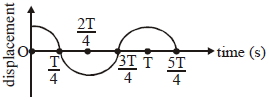
- 7The displacement time graph of a particle executing $S.H.M.$ is given in figure: (sketch is schematic and not to scale) Which of the following statements is are true for this motion?View Solution
$(A)$ The force is zero $t=\frac{3 T}{4}$
$(B)$ The acceleration is maximum at $t=T$
$(C)$ The speed is maximum at $t =\frac{ T }{4}$
$(D)$ The $P.E.$ is equal to $K.E.$ of the oscillation at $t=\frac{T}{2}$
- 8The equation of $SHM$ of a particle is given asView Solution
$2\,\frac{{{d^2}x}}{{d{t^2}}} + 32x = 0$
where $x$ is the displacement from the mean position of rest. The period of its oscillation (in seconds) is
- 9The function $sin^2\,(\omega t)$ representsView Solution
- 10If the time period of a two meter long simple pendulum is $2\, s$, the acceleration due to gravity at the place where pendulum is executing $S.H.M.$ isView Solution