The condensers of capacity ${C_1}$ and ${C_2}$ are connected in parallel, then the equivalent capacitance is
Easy


Download our appand get started for free
Experience the future of education. Simply download our apps or reach out to us for more information. Let's shape the future of learning together!No signup needed.*
Similar Questions
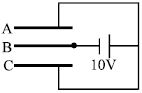
- 1Three plates $A, B$ and $C$ each of area $0.1 \ m^2$ are separated by $0.885\ mm$ from each other as shown in the figure. $A$ $10$ $V$ battery is used to charge the system. The energy stored in the system isView Solution
- 2An electric dipole of moment $p$ is placed in an electric field of intensity $E.$ The dipole acquires a position such that the axis of the dipole makes an angle $\theta$ with the direction of the field. Assuming that the potential energy of the dipole to be zero when $\theta = 90^o$ , the torque and the potential energy of the dipole will respectively beView Solution
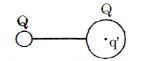
- 3Two conducting hollow sphere of radius $R$ and $3R$ are found to have $Q$ charge on outer surface when both are connected with a long wire and $q'$ charge is kept at the centre of bigger sphere. Then which one is trueView Solution
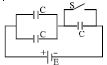
- 4In the circuit shown, each capacitor has a capacitance $C$. The emf of the cell is $E$. If the switch $S$ is closedView Solution
- 5A parallel plate capacitor of plate area $A$ and plate separation $d$ is charged to potential $V$ and then the battery is disconnected. A slab of dielectric constant $k$ is then inserted between the plates of the capacitors so as to fill the space between the plates. If $Q,\;E$ and $W$ denote respectively, the magnitude of charge on each plate, the electric field between the plates (after the slab is inserted) and work done on the system in question in the process of inserting the slab, then state incorrect relation from the followingView Solution
- 6Capacitance of a parallel plate capacitor becomes $4/3$ times its original value if a dielectric slab of thickness $t = d/2$ is inserted between the plates ($d$ is the separation between the plates). The dielectric constant of the slab isView Solution
- 7An infinite number of charges each equal to $0.2\,\mu C$ are arranged in a line at distances $1\,m, 2\,m, 4\,m, 8\,m......$ from a fixed point. The potential at fixed point is ......$kV$View Solution
- 8A cube of side $b$ has a charge $q$ at each of its vertices. Determine the potential and electric field due to this charge array at the centre of the cube.View Solution
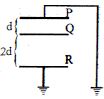
- 9See the diagram . Area of each plate is $2.0\ m^2$ and $d = 2 \times 10^{-3}\ m$. A charge of $8.85 \times 10^{-8}\ C$ is given to $Q$. Then the potential of $Q$ becomes......$V$View Solution
- 10The energy stored in a condenser of capacity $C$ which has been raised to a potential $V$ is given byView Solution