The energy stored in a condenser of capacity $C$ which has been raised to a potential $V$ is given by
AIPMT 1996, Easy
Download our app for free and get started
(b) $U = \int_{\,0}^{\,V} {CV\,dV} = \frac{1}{2}\,C{V^2}$

Download our appand get started for free
Experience the future of education. Simply download our apps or reach out to us for more information. Let's shape the future of learning together!No signup needed.*
Similar Questions
- 1A condenser of $2\,\mu F$ capacitance is charged steadily from $0$ to $5\,C$. Which of the following graph represents correctly the variation of potential difference $(V)$ across it's plates with respect to the charge $(Q)$ on the condenser?View Solution
- 2A resistance $R$ and a capacitance $C$ are connected in series to a battery of negligible internal resistance through a key. The key is closed at $t = 0$. If after $t\, sec$ the voltage across the capacitance was seven times the voltage across $R$, the value of $t$ isView Solution
- 3Two charges of magnitude $+ q$ and $-\,3q$ are placed $100\,cm$ apart. The distance from $+ q$ between the charges where the electrostatic potential is zero is.......$cm$View Solution
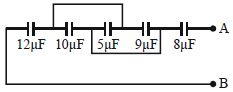
- 4Five capacitors together with their capacitances are shown in the adjoining figure. The potential difference between the points $A$ and $B$ is $60\, volt$. The equivalent capacitance between the point $A$ and $B$ and charge on capacitor $5 \mu F$ will be respectively:-View Solution
- 5A capacitor of capacity $C$ has charge $Q$ and stored energy is $W$. If the charge is increased to $2Q$, the stored energy will beView Solution
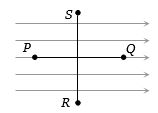
- 6View SolutionThepoints resembling equal potentials are
- 7If the potential at the centre of a uniformly charged hollow sphere of radius $R$ is $V$ then electric field at a distance $r$ from the centre of the sphere is $(r > R)$View Solution
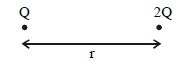
- 8Mass of charge $Q$ is $m$ and mass of charge $2Q$ is $4\,m$ . If both are released from rest, then what will be $K.E.$ of $Q$ at infinite separationView Solution
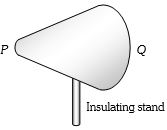
- 9Figure shows a charged conductor resting on an insulating stand. If at the point $P$ the charge density is $\sigma $, the potential is $V$ and the electric field strength is $E$, what are the values of these quantities at point $Q$View Solution
Charge density potential Electric intensity
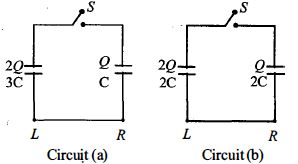
- 10Two circuits $(a)$ and $(b)$ have charged capacitors of capacitance $C, 2C$ and $3C$ with open switches. Charges on each of the capacitor are as shown in the figures. On closing the switchesView Solution