A cube of side $b$ has a charge $q$ at each of its vertices. Determine the potential and electric field due to this charge array at the centre of the cube.
Medium
Download our app for free and get started
Length of the side of a cube $=b$
Charge at each of its vertices $=q$
A cube of side $b$ is shown in the following figure.
$d =$ Diagonal of one of the six faces of the cube
$d^{2}=\sqrt{b^{2}+b^{2}}=\sqrt{2 b^{2}}$
$d=b \sqrt{2}$
$l=$ Length of the diagonal of the cube
$l^{2}=\sqrt{d^{2}+b^{2}}$
$=\sqrt{(\sqrt{2} b)^{2}+b^{2}}=\sqrt{2 b^{2}+b^{2}}=\sqrt{3 b^{2}}$
$l=b \sqrt{3}$
$r=\frac{l}{2}=\frac{b \sqrt{3}}{2}$ is the distance between the centre of the cube and one of the eight vertices The electric potential $(V)$ at the centre of the cube is due to the presence of eight charges at the vertices.
$V=\frac{8 q}{4 \pi \epsilon_{0}}$
$=\frac{8 q}{4 \pi \epsilon_{0}\left(b \frac{\sqrt{3}}{2}\right)}$
$=\frac{4 q}{\sqrt{3} \pi \epsilon_{0} b}$
Therefore, the potential at the centre of the cube is $\frac{4 q}{\sqrt{3} \pi \epsilon_{0} b}$
The electric field at the centre of the cube, due to the eight charges, gets cancelled. This is because the charges are distributed symmetrically with respect to the centre of the cube. Hence, the electric field is zero the centre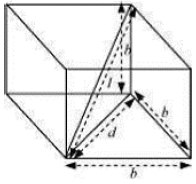

Download our appand get started for free
Experience the future of education. Simply download our apps or reach out to us for more information. Let's shape the future of learning together!No signup needed.*
Similar Questions
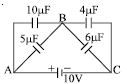
- 1In the circuit shown in figure, four capacitors are connected to a battery. A parallel plate capacitor has an electric field of $10^5\ V/m$ between the plates. If the charge on the capacitor plate is $1\ \mu C$, then the force on each capacitor plate is.....$Nt$View Solution
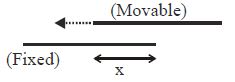
- 2A parallel-plate capacitor consists of a fixed plate and a movable plate that is allowed to slide in the direction parallel to the plates. Let $x$ be the distance of overlap, as shown in the figure. The separation between the plates is fixed. Assume that the plates are electrically isolated, so that their charges $±Q$ are constant. Force on the movable plate is proportional toView Solution
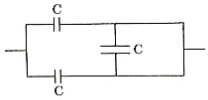
- 3View SolutionThe equivalent capacitance of the combination shown in the figure is :
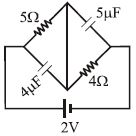
- 4Find the ratio of energy stored in $5\,\mu F$ and $4\,\mu F$ capacitor in the given circuit in steady stateView Solution
- 5Two equal positive point charges are kept at points $A$ and $B$ . The electric potential, while moving from $A$ to $B$ along straight lineView Solution
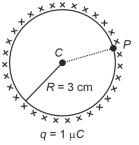
- 6A thin spherical shell is charged by some source. The potential difference between the two points $C$ and $P$ (in $V$) shown in the figure is:View Solution
(Take $\frac{1}{4 \pi \varepsilon_0}=9 \times 10^9$ $SI$ units)
- 7A capacitor having capacitance $C$ is charged to a voltage $V$. It is then removed and connected in parallel with another identical capacitor which is uncharged. The new charge on each capacitor is nowView Solution
- 8capacitor is used to store $24\, watt\, hour$ of energy at $1200\, volt$. What should be the capacitance of the capacitorView Solution
- 9Two charges of magnitude $5\, nC$ and $-2\, nC$, one placed at points $(2\, cm, 0, 0)$ and $(x\, cm, 0, 0)$ in a region of space, where there is no other external field. If the electrostatic potential energy of the system is $ - 0.5\,\mu J$. The value of $x$ is.....$cm$View Solution
- 10In the given circuit if point $C$ is connected to the earth and a potential of $ + \,2000\,V$ is given to the point $A$, the potential at $B$ is.....$V$View Solution