$1\, m^3$ water is brought inside the lake upto $200$ metres depth from the surface of the lake. What will be change in the volume when the bulk modulus of elastically of water is $22000$ atmosphere? (density of water is $1\times10^3\, kg/m^3$ atmosphere pressure $= 10^5\, N/m^2$ and $g = 10\, m/s^2$)
Medium


Download our appand get started for free
Experience the future of education. Simply download our apps or reach out to us for more information. Let's shape the future of learning together!No signup needed.*
Similar Questions
- 1A brass rod of cross-sectional area $1\,c{m^2}$ and length $0.2\, m$ is compressed lengthwise by a weight of $5\, kg$. If Young's modulus of elasticity of brass is $1 \times {10^{11}}\,N/{m^2}$ and $g = 10\,m/{\sec ^2}$, then increase in the energy of the rod will beView Solution
- 2The relationship between Young's modulus $Y,$ Bulk modulus $K$ and modulus of rigidity $\eta $ isView Solution
- 3View SolutionAccording to Hook’s law of elasticity, if stress is increased, the ratio of stress to strain
- 4View SolutionThe reason for the change in shape of a regular body is
- 5The bulk modulus of a spherical object is '$B$'. If it is subjected to uniform pressure '$P$', the fractional decrease in radius isView Solution
- 6The force required to punch a square hole $2\,cm$ side in steel sheet $2\,mm$ thick is (shearing stress of steel sheet $= 3.5\times 10^8\,\,N/m^2$ )View Solution
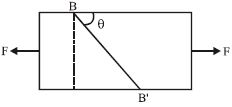
- 7A bar of cross-sectional area $A$ is subjected two equal and opposite tensile forces at its ends as shown in figure. Consider a plane $BB'$ making an angle $\theta $ with the length The ratio of tensile stress to the shearing stress on the plane $BB'$ isView Solution
- 8View SolutionBulk modulus was first defined by
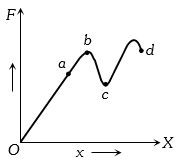
- 9The graph is drawn between the applied force $F$ and the strain $(x)$ for a thin uniform wire. The wire behaves as a liquid in the partView Solution
- 10View SolutionWhich of the following is the graph showing stress-strain variation for elastomers?