MCQ
The correct IUPAC name of the following alkane is:
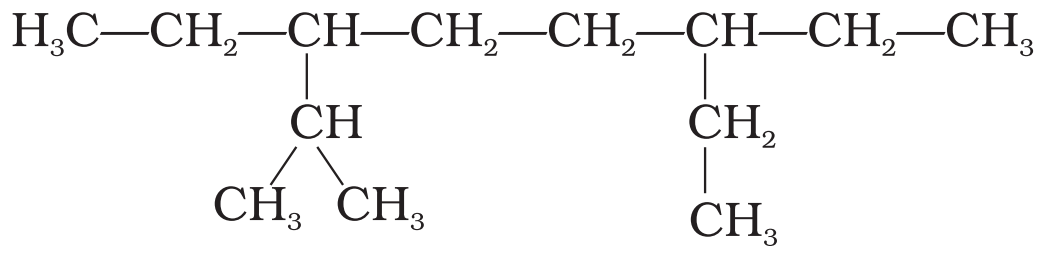
- A3, 6 – Diethyl – 2 – methyloctane.
- B5 – Isopropyl – 3 – ethyloctane.
- C3 – Ethyl – 5 – isopropyloctane.
- D3 – Isopropyl – 6 – ethyloctane.
Explanation:
$\ \ \ \ \ \ \ \ \ \ \ \ \ \ \ \ \ \ \ \ \ \ \ \ \ \ \ \ 3\ \ \ \ \ \ \ \ \ \ 4\ \ \ \ \ \ \ \ \ \ 5\ \ \ \ \ \ \ \ \ \ 6\ \ \ \ \ \ \ \ \ \ 7\ \ \ \ \ \ \ \ \ \ 8\\\text{H}_3\text{C}\ \ -\ \text{CH}_2-\text{CH}-\text{CH}_2-\text{CH}_2-\text{CH}-\text{CH}_2-\text{CH}_3\\ \ \ \ \ \ \ \ \ \ \ \ \ \ \ \ \ \ \ \ \ \ \ \ \ \ \ \ \ \ |\ \ \ \ \ \ \ \ \ \ \ \ \ \ \ \ \ \ \ \ \ \ \ \ \ \ \ \ \ \ \ \ \ \ \ |\\\ \ \ \ \ \ \ \ \ \ \ \ \text{CH}_3-\ ^2\text{CH}\ \ \ \ \ \ \ \ \ \ \ \ \ \ \ \ \ \ \ \ \ \ \ \ \ \ \ \ \ \ \ \text{CH}_2\\\ \ \ \ \ \ \ \ \ \ \ \ \ \ \ \ \ \ \ \ \ \ \ \ \ \ \ \ |\ \ \ \ \ \ \ \ \ \ \ \ \ \ \ \ \ \ \ \ \ \ \ \ \ \ \ \ \ \ \ \ \ \ \ \ |\\\ \ \ \ \ \ \ \ \ \ \ \ \ \ \ \ \ \ \ \ \ \ \ \ \ ^1\text{CH}_3\ \ \ \ \ \ \ \ \ \ \ \ \ \ \ \ \ \ \ \ \ \ \ \ \ \ \ \ \ \ \text{CH}_3\\\ \ \ \ \ \ \ \ \ \ \ \ \ \ \ \ \ \ \ \ \ \ \ 3,6-\text{Diethyl}-2-\text{methyloctane}$
Generate a complete, print-ready paper with questions like this in minutes — across 16+ boards, with answer keys.
i.$\frac{\text{K}^+}{\text{K}}=-3.02\text{V}$ ii.$\frac{\text{Cu}^{2+}}{\text{Cu}}=+0.34\text{V}$
iii.$\frac{\text{Hg}^{2+}}{\text{Hg}}=0.92\text{V}$ iv.$\frac{\text{Cr}^{3+}}{\text{Cr}}=-0.74\text{V}$
Decreasing order of reducing power of these elements is:
$(R = 0.083\, L\, bar\, K^{-1} \,mol^{-1})$