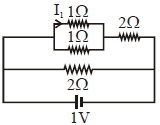
The current $I_{1}$ (in $A$) flowing through $1\; \Omega$ resistor in the following circuit is:
JEE MAIN 2020, Medium
Download our app for free and get started
Equivalent resistance of upper branch of circuit $\mathrm{R}=2.5 \Omega$
Voltage across upper branch $=1 \mathrm{V}$
$\Rightarrow \quad i=\frac{1}{2.5}=.4 \mathrm{A}$
$\Rightarrow \mathrm{I}_{1}=0.2 \mathrm{A}$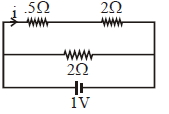

Download our appand get started for free
Experience the future of education. Simply download our apps or reach out to us for more information. Let's shape the future of learning together!No signup needed.*
Similar Questions
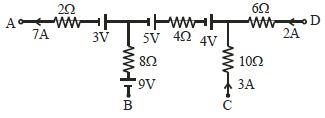
- 1Temperature coefficient at $0\,^oC$ is $0.00125\,^oC^{-1}$. At a temperature of $25\,^oC$ its resistance is $1\,\Omega $. Find the temperature at which resistance is $1.2\,\Omega $View Solution
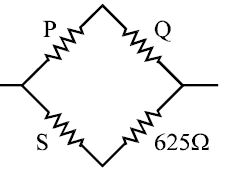
- 2$A$ Wheatstone's bridge is balanced with a resistance of $625\, \Omega$ in the third arm, where $P, Q$ and $S$ are in the $1^{st}, 2^{nd}$ and $4^{th}$ arm respectively. If $P$ and $Q$ are interchanged, the resistance in the third arm has to be increased by $51\,\Omega$ to secure balance. The unknown resistance in the fourth arm is ............. $\Omega$View Solution
- 3The drift velocity of electrons in silver wire with cross-sectional area $3.14 \times 10^{-6}\,m ^2$ carrying a current of $20\,A$ is. Given atomic weight of $Ag =108$ , density of silver $=10.5 \times 10^3\,kg / m ^3..........\times 10^{-4} m / sec$.View Solution
- 4Masses of $3$ wires of same metal are in the ratio $1 : 2 : 3$ and their lengths are in the ratio $3 : 2 : 1$. The electrical resistances are in ratioView Solution
- 5Two wires of resistance $R_1$ and $R_2$ have temperature coefficient of resistance ${\alpha _1\,}{\rm{ and \,}}{\alpha _2}$, respectively. These are joined in series. The effective temperature coefficient of resistance isView Solution
- 6A current of two amperes is flowing through a cell of $e.m.f.$ $5\, volts$ and internal resistance $0.5\, ohm$ from negative to positive electrode. If the potential of negative electrode is $10\,V$, the potential of positive electrode will be .............. $V$View Solution
- 7A copper wire of length $1\, m$ and radius $1\, mm$ is joined in series with an iron wire of length $2\, m$ and radius $3\, mm$ and a current is passed through the wires. The ratio of the current density in the copper and iron wires isView Solution
- 8In a potentiometer wire experiment the $\mathrm{emf}$ of a battery in the primary circuit is $20\,V$ and its internal resistance is $5\,\Omega$ . There is a resistance box in series with the battery and the potentiometer wire, whose resistance can be varied from $120\,\Omega$ to $170\,\Omega$ . Resistance of the potentiometer wire is $75\,\Omega$ . The following potential differences can be measured using this potentiometer.View Solution
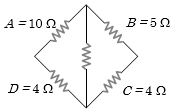
- 9In a typical Wheatstone network, the resistances in cyclic order are $A = 10 \,\Omega $, $B = 5 \,\Omega $, $C = 4 \,\Omega $ and $D = 4 \,\Omega $ for the bridge to be balancedView Solution
- 10In a portion of some large electrical network, curents in certain branches are known as shown in figure The value of $V_A -V_C$ is ............... $V$View Solution