Question
The current in a conductor and the potential difference across its ends are measured by an ammeter and a voltmeter. The meters draw negligible currents. The ammeter is accurate but the voltmeter has a zero error (that is, it does not read zero when no potential difference is applied). Calculate the zero error if the readings for two different conditions are 1.75A, 14.4V and 2.75A, 22.4V.
Answer

Let the voltmeter reading when, the voltage is 0 be X.
$\frac{\text{l}_1\text{R}}{\text{l}_2\text{R}}=\frac{\text{V}_1}{\text{V}_2}$
$\Rightarrow\frac{1.75}{2.75}=\frac{14.4-\text{V}}{22.4-\text{V}}$
$\Rightarrow\frac{0.35}{0.55}=\frac{14.4-\text{V}}{22.4-\text{V}}$
$\Rightarrow\frac{0.07}{0.11}=\frac{14.4-\text{V}}{22.4-\text{V}}$
$\Rightarrow\frac{7}{11}=\frac{14.4-\text{V}}{22.4-\text{V}}$
$\Rightarrow7(22.4-\text{V})=11(14.4-\text{V})$
$\Rightarrow156.8-7\text{V}=158.4-11\text{V}$
$\Rightarrow(7-11)\text{V}=156.8-158.4\Rightarrow-4\text{V}=-1.6$
$\Rightarrow\text{V}=0.4\text{V}.$

Need a full question paper?

Generate a complete, print-ready paper with questions like this in minutes — across 16+ boards, with answer keys.

Start Generating Free

Similar questions

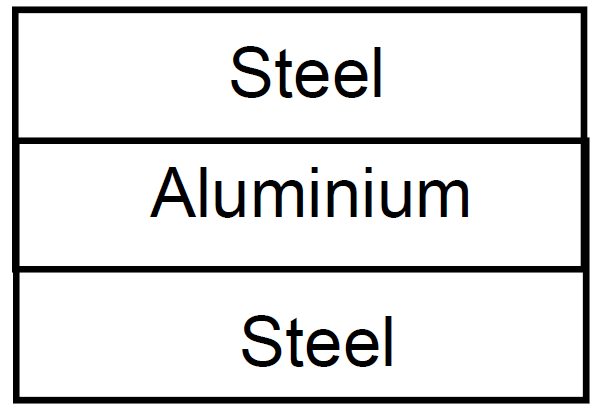
Two steel rods and an aluminium rod of equal length $l_0$ and equal cross section are joined rigidly at their ends as shown in the figure below. All the rods are in a state of zero tension at $0^\circ C$. Find the length of the system when the temperature is raised to $\theta$. Coefficient of linear expanaion of aluminium and steel are $\alpha_\text{a}$ and $\alpha_\text{s}$respectively. Young's modulus of aluminium is $Y_a$ and of steel is $Y_s.$​​​​​​​
Establish the formula for the capacitance of a parallel plate capacitor in the presence of dielectric material completely and partially.
Establish an expression for induced electromotive force due to rotational motion of a conducting rod in a uniform magnetic field.
A professor reads a greeting card received on his 50th birthday with +2.5D glasses keeping the card 25cm away. Ten years later, he reads his farewell letter with the same glasses but he has to keep the letter 50cm away. What power of lens should he now use?
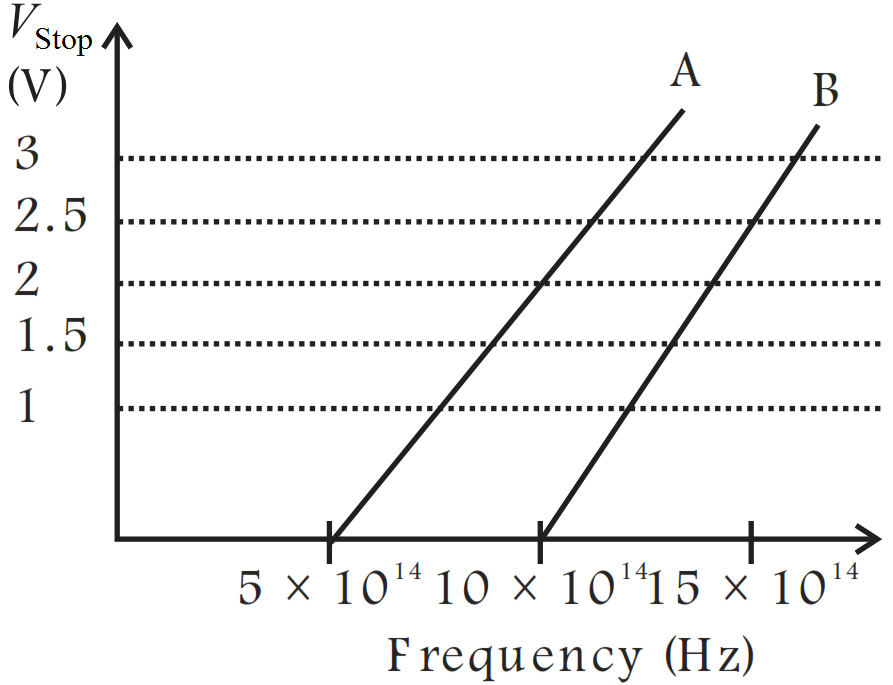
A student performs an experiment on photoelectric effect, using two materials A and B. A plot of Vstop vs ν is given in Fig.
  1. Which material A or B has a higher work function?
  2. Given the electric charge of an electron $= 1.6 \times 10^{-19}C$, find the value of h obtained from the experiment for both A and B.
Comment on whether it is consistent with Einstein’s theory:
  1. Draw the circuit arrangement for studying the input and output characteristics of an n-p-n transistor in CE configuration. With the help of these characteristics define (i) input resistance, (ii) current amplification factor.
  2. Describe briefly with the help of a circuit diagram how an n-p-n transistor is used to produce self-sustained oscillations.
A horizontal cesium plate ($\phi$ = l.9 eV) is moved vertically downward at a constant speed u in a room full of radiation of wavelength 250 run and above. What should be the minimum value of u so that the vertically upward component of velocity is nonpositive for each photoelectron?
Consider the situation shown in figure. The elevator is going up with an acceleration of $2.00m/s^2$ and the focal length of the mirror is 12.0cm. All the surfaces are smooth and the pulley is light. The mass-pulley system is released from rest (with respect to the elevator) at t = 0 when the distance of B from the mirror is 42.0cm. Find the distance between the image of the block B and the mirror at t = 0.200s. Take $g = 10m/s^2.$​​​​​​​
With the help of a ray diagram, show the formation of image of a point object due to refraction of light at a spherical surface separating two media of refractive indices $n_1$ and $n_2 (n_2 > n_1)$ respectively. Using this diagram, derive the relation.
$\frac{\text{n}_2}{\text{v}}-\frac{\text{n}_1}{\text{u}}=\frac{\text{n}_1-\text{n}_2}{\text{R}}$
Write the sign conventions used. What happens to the focal length of convex lens when it is immersed in water?
In a Young's double slit experiment using monochromatic light, the fringe pattern shifts by a certain distance on the screen when a mica sheet of refractive index 1.6 and thickness 1.964 micron $(1$ micron $= 10^{-6}m)$ is introduced in the path of one of the interfering waves. The mica sheet is then removed and the distance between the screen and the slits is doubled. It is found that the distance between the successive maxima now is the same as the observed fringe-shift upon the introduction of the mica sheet. Calculate the wavelength of the monochromatic light used in the experiment.