A professor reads a greeting card received on his 50th birthday with +2.5D glasses keeping the card 25cm away. Ten years later, he reads his farewell letter with the same glasses but he has to keep the letter 50cm away. What power of lens should he now use?
Download our app for free and get started
On the 50th birthday, he reads the card at a distance 25cm using a glass of +2.5D.Ten years later, his near point must have changed.
So after ten years,
$\text{u}=-50\text{cm},$
$\text{f}=\frac{1}{2.5\text{D}}=0.4\text{m}=40\text{cm}$
$\text{v}=\text{near point}$
Now, $\frac{1}{\text{v}}-\frac{1}{\text{u}}=\frac{1}{\text{f}}$
$\Rightarrow \frac{1}{\text{v}}=\frac{1}{\text{u}}+\frac{1}{\text{f}}=\frac{1}{-50}+\frac{1}{40}=\frac{1}{200}$
So, near point = v = 200cm
To read the farewell letter at a distance of 25cm,
U = –25cm
For lens formula,
$\Rightarrow\frac{1}{\text{v}}-\frac{1}{\text{u}}=\frac{1}{\text{f}}$
$\Rightarrow\frac{1}{\text{f}}=\frac{1}{200} -\frac{1}{-25}=\frac{1}{200}+\frac{1}{25}=\frac{9}{200}$
$\Rightarrow\text{f}=\frac{200}{9}\text{cm}=\frac{2}{9}\text{m}$
⇒ Power of the lens $=\frac{1}{\text{f}}=\frac{9}{2}=4.5\text{D.}$
$\therefore$ He has to use a lens of power +4.5D.
So after ten years,
$\text{u}=-50\text{cm},$
$\text{f}=\frac{1}{2.5\text{D}}=0.4\text{m}=40\text{cm}$
$\text{v}=\text{near point}$
Now, $\frac{1}{\text{v}}-\frac{1}{\text{u}}=\frac{1}{\text{f}}$
$\Rightarrow \frac{1}{\text{v}}=\frac{1}{\text{u}}+\frac{1}{\text{f}}=\frac{1}{-50}+\frac{1}{40}=\frac{1}{200}$
So, near point = v = 200cm
To read the farewell letter at a distance of 25cm,
U = –25cm
For lens formula,
$\Rightarrow\frac{1}{\text{v}}-\frac{1}{\text{u}}=\frac{1}{\text{f}}$
$\Rightarrow\frac{1}{\text{f}}=\frac{1}{200} -\frac{1}{-25}=\frac{1}{200}+\frac{1}{25}=\frac{9}{200}$
$\Rightarrow\text{f}=\frac{200}{9}\text{cm}=\frac{2}{9}\text{m}$
⇒ Power of the lens $=\frac{1}{\text{f}}=\frac{9}{2}=4.5\text{D.}$
$\therefore$ He has to use a lens of power +4.5D.

Download our appand get started for free
Experience the future of education. Simply download our apps or reach out to us for more information. Let's shape the future of learning together!No signup needed.*
Similar Questions
- 1View Solution
- A point object is placed on the principal axis of a convex spherical surface of radius of curvature R, which separates the two media of refractive indices $n_1$ and $n_2(n_2 > n_1)$. Draw the ray diagram and deduce the relation between the object distance (u), image distance (v) and the radius of curvature (R) for refraction to take place at the convex spherical surface from rarer to denser medium.
- A converging lens has a focal length of 20 cm in air. It is made of a material of refractive index 1.6. If it is immersed in a liquid of refractive index 1.3, find its new focal length.
- 2A hemispherical portion of the surface of a solid glass sphere $(\mu=1.5)$ of radius r is silvered to make the inner side reflecting. An object is placed on the axis of the hemisphere at a distance 3r from the centre of the sphere. The light from the object is refracted at the unsilvered part, then reflected from the silvered part and again refracted at the unsilvered part. Locate the final image formed.View Solution
- 3View SolutionAn object 1.5 cm in size is placed on the side of the convex lens in the arrangement (a) above. The distance between the object and the convex lens is 40 cm. Determine the magnification produced by the two-lens system, and the size of the image.
- 4View SolutionDetermine the ‘effective focal length’ of the combination of the two lenses in if they are placed 8.0 cm apart with their principal axes coincident. Does the answer depend on which side of the combination a beam of parallel light is incident? Is the notion of effective focal length of this system useful at all.
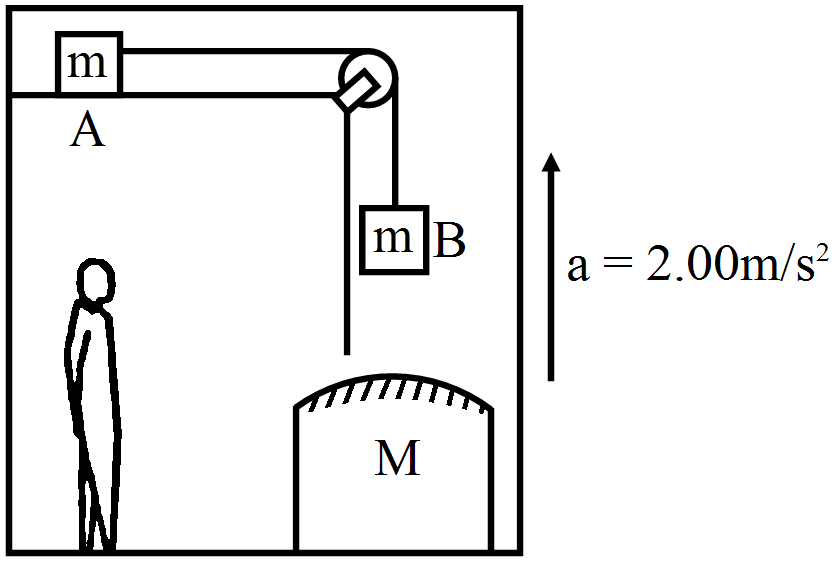
- 5Consider the situation shown in figure. The elevator is going up with an acceleration of $2.00m/s^2$ and the focal length of the mirror is 12.0cm. All the surfaces are smooth and the pulley is light. The mass-pulley system is released from rest (with respect to the elevator) at t = 0 when the distance of B from the mirror is 42.0cm. Find the distance between the image of the block B and the mirror at $t = 0.200s$. Take $g = 10m/s^2$.View Solution
- 6View SolutionA pin of length 2.0cm lies along the principal axis of a converging lens, the centre being at a distance of 11cm from the lens. The focal length of the lens is 6cm. Find the size of the image.
- 7View SolutionA pin of length 2.00cm is placed perpendicular to the principal axis of a converging lens. An inverted image of size 1.00cm is formed at a distance of 40.0cm from the pin. Find the focal length of the lens and its distance from the pin.
- 8For a glass prism $(\mu=\sqrt{3})$ the angle of minimum deviation is equal to the angle of the prism. Find the angle of the prism.View Solution
- 9View SolutionThe mixture a pure liquid and a solution in a long vertical column (i.e, horizontal dimensions < < vertical dimensions) produces diffusion of solute particles and hence a refractive index gradient along the vertical dimension. A ray of light entering the column at right angles to the vertical is deviated from its original path. Find the deviation in travelling a horizontal distance d < < h, the height of the column.
- 10View Solution
- Draw a ray diagram showing the image formation by a compound microscope. Hence obtain expression for total magnification when the image is formed at infinity.
- Distinguish between myopia and hypermetropia. Show diagrammatically how these defects can be corrected.